
Quick Answer: Under the new traffic rules 2026 India package, you have 45 days from the date a challan is issued to pay it or contest it online — ignore it and it is treated as accepted. Five or more offences in a year (counted from 1 January 2026) is now a ground for disqualifying your driving licence. And since 15 August 2026, a first minor offence under Sections 177, 177A, 190(2)(ii) or 194F draws a recorded warning instead of a fine. An unpaid challan — or an unpaid National Highway toll — can block your licence and registration work until it is cleared.
If you drive in India, the new traffic rules 2026 india changes are the ones that decide what happens after you get a challan — how long you have, what it costs to ignore it, and what else stops working while it sits unpaid. They did not arrive as one big new fine list. They came as three separate Gazette changes between January and August 2026, plus a fitness-rules change in May, and each one does something different. This guide puts them together in plain language, with the Gazette number and date for every claim, so you can check any of it yourself.
One thing to get out of the way first: your fines for the serious offences have not gone up in 2026. Drunk driving, overspeeding, dangerous driving, driving without a licence, and the helmet and seat-belt penalties are what they were under the 2019 amendment. What changed is the process around a challan — the clock you are on, what an unpaid challan blocks, what happens if you keep offending, and a warning instead of a fine for a first minor slip. The exact amount on your challan is still the amount that applies to you, and it can differ by state.
Contents
- What changed in 2026 — the four changes, in date order
- The 45-day rule, explained step by step
- The 5-strike licence rule
- The Jan Vishwas warning rule
- What an unpaid challan — or unpaid toll — blocks
- What to do if you get a challan
- What the new traffic rules 2026 india did not change
- FAQs
- Sources
What changed in 2026 — the four changes, in date order
Four instruments, four dates. They are often mixed up in forwards and news reports — most commonly, the toll rule is wrongly attached to the fitness-rules notification — so here they are, separated, with what each one actually does.
14 January 2026 — unpaid toll blocks NOC, fitness and National Permit (G.S.R. 28(E))
The Central Motor Vehicles (Second Amendment) Rules, 2026 — G.S.R. 28(E), dated 13 January 2026, in force 14 January 2026 — introduced a new definition of “unpaid user fee”: a National Highway toll recorded by the Electronic Toll Collection (ETC) system, such as FASTag, where the fee was never received under the National Highways Act, 1956. The Ministry announced it on 20 January 2026 (PIB), and the rule is simple and strict: until that unpaid toll is cleared, a No Objection Certificate (NOC) for transfer of ownership or for moving the vehicle to another state will not be granted, a Certificate of Fitness will not be renewed or generated, and a commercial vehicle seeking a National Permit must have no unpaid user fee against it. Form 28 — the NOC application — was changed at the same time, so applicants must now disclose whether any unpaid toll demand is pending against the vehicle. This is the rule that matters when you sell a car or move states: check the toll dues on the registration number before the money moves, not after.
21 January 2026 — the new challan rules (G.S.R. 48(E))
The Central Motor Vehicles (Third Amendment) Rules, 2026 — G.S.R. 48(E), dated 20 January 2026, published in the Gazette on 21 January 2026 and in force from publication — rewrote Rule 167 (the procedure for issuing and paying a challan) and added a new ground for licence disqualification under Rule 21. This is the change this article is mostly about, and it is covered in full in the two sections below. In short: a challan must now reach you within 3 days electronically or 15 days on paper, you have 45 days to pay or contest it, and an unpaid challan can freeze your licence and registration work and get the vehicle flagged “Not to be Transacted” on the portal.
8 May 2026 — the fitness rules (G.S.R. 349(E))
The Central Motor Vehicles (Sixth Amendment) Rules, 2026 — G.S.R. 349(E), dated 8 May 2026 — rewrote the fitness-certificate rules under Rule 62. A new, fully built non-transport (private) vehicle is now treated as fit for 15 years from registration, and a renewed fitness certificate lasts 5 years. Where an automated testing station is working in your area, light motor vehicles are tested there, a geo-tagged video through a government app is needed at renewal, and the checks now cover the speed governor, location tracking device, high security registration plate (HSRP), reflectors and seat belts. Note carefully: this notification is about fitness testing. The rule that an unpaid toll blocks a fitness certificate is the January rule above (G.S.R. 28(E)), not this one — the two are separate notifications that both touch Rule 62, which is why they get confused.
15 August 2026 — Jan Vishwas changes to the Motor Vehicles Act
The Jan Vishwas (Amendment of Provisions) Act, 2026 — Act 8 of 2026, which received the President’s assent on 7 April 2026 and was published in the Gazette on 8 April 2026 — amends dozens of central laws at once to decriminalise minor offences. Its Motor Vehicles Act part (serial number 51 in the Schedule) was brought into force on 15 August 2026 by Ministry of Road Transport and Highways notification S.O. 4100(E), dated 24 July 2026. For drivers, its two headline changes are a recorded warning instead of a fine for a first minor contravention, and a 30-day period after expiry during which a driving licence stays effective. The detail is in the Jan Vishwas section below.
The 45-day rule, explained step by step
Rule 167, as substituted on 21 January 2026, sets a fixed timetable for every challan — physical or electronic, issued by a police officer or auto-generated by an electronic monitoring system. Here is the timetable, in the order it runs:
- The challan must reach you — 3 days electronically, 15 days on paper. A challan issued electronically (SMS, e-mail or another authorised electronic means) must be delivered within 3 days; a physical challan, by hand or other physical means, within 15 days. Camera challans under Rule 167A carry the same 3-day / 15-day delivery rule, and must be accompanied by a notice of the offence. If you only hear about a challan weeks later, the date on the challan itself is what the 45-day clock runs from — check it.
- You have 45 days from the date of issue to pay or contest. Within 45 days, you either accept the amount in the challan and pay it, or you contest the challan on the portal with documentary evidence (photos, video, or other documents) before the authority your state government has specified. The contest route is on the portal — it is not a visit to a court in the first instance.
- No response in 45 days — the challan is treated as accepted. If you do not contest it, the challan is deemed accepted on the expiry of the 45 days, and the amount must then be paid — in physical or electronic form — within the next 30 days.
- If you contested it, the authority has 30 days to decide. If the authority does not resolve your contest within 30 days after the 45-day period, or if it quashes the challan for reasons recorded in writing after hearing your evidence, the challan ceases to have effect and the order is uploaded on the portal.
- If your contest is rejected, you get another choice — pay in 30 days, or go to court. If the authority rejects your submissions with reasons recorded in writing, you may either pay the challan within 30 days of receiving the order (or of its upload on the portal), or file an application before a court after depositing 50% of the challan amount in the manner your state specifies. If you do neither within those 30 days, the challan is again deemed accepted and must be paid within the next 15 days.
- While an accepted challan stays unpaid, you get a reminder every day. Rule 167(11) provides that a notice is sent through electronic means every day from the expiry of the payment periods above.
Two practical points. First, the 45 days run from the date the challan was issued, not from the day you happen to open the SMS — so check for pending challans regularly on the official portal, echallan.parivahan.gov.in, rather than waiting for a message. Second, never pay from a link in an SMS or WhatsApp message: type the portal address yourself. Fake e-challan messages are a known scam, and the government has warned about them.
The 5-strike licence rule
From 1 January 2026, committing five or more offences or contraventions of the Motor Vehicles Act or the Central Motor Vehicles Rules in a period of one year is a ground on which the licensing authority can disqualify a driver. That is the new clause (25) inserted in Rule 21(1) by G.S.R. 48(E). Three things about it are worth understanding properly, because it is widely misreported:
- It is a ground for disqualification, not an automatic cancellation. Five offences give the licensing authority a reason to disqualify you; they do not cancel your licence by themselves the moment the fifth challan is issued. The decision sits with the authority.
- The count starts on 1 January 2026. Only offences recorded in a one-year period commencing on and from 1 January 2026 count. And offences from one one-year period are not carried into the next: the rule expressly says no offence recorded in any previous one-year period shall be taken into account for determining offences in a subsequent one-year period.
- It counts offences, not just fines paid. The clause covers offences or contraventions of the Act or the rules — so a challan you contested and lost, or one that was deemed accepted, still sits on the record. The practical lesson is the boring one: the fifth challan in a year is the one that puts your licence at risk, so the first four are not free.
This is not a points system. No notified all-India points system for driving licences was found during research for this article — the 2026 rule that counts repeat offending is this disqualification ground, not a points tally. If a message tells you that you have “lost points” on your licence, treat it with suspicion and check the portal.
The Jan Vishwas warning rule
From 15 August 2026, the Motor Vehicles Act treats a first minor slip differently from a repeat one. Under the Jan Vishwas amendments, a first contravention under the following sections now draws a warning, recorded in the manner the Central Government prescribes — not a fine:
- Section 177 — the general penalty, which applies where the Act or the rules prescribe no specific penalty for the offence. First contravention: a warning. Second or subsequent contravention: a penalty of ₹500 to ₹1,500. (Before 15 August 2026, a first offence under this section drew a fine of up to ₹500.)
- Section 177A — contravention of the road regulations made under Section 118 (traffic regulations, lane discipline, road signs). First contravention: a warning. Second or subsequent: a penalty of ₹500 to ₹1,000. If the same act is also punishable under another provision, only that other provision’s penalty applies.
- Section 194F — sounding the horn needlessly or continuously, sounding it in a no-horn zone, or driving with a cut-out that bypasses the silencer. First contravention: a warning. Second or subsequent: ₹1,000 to ₹2,000.
- Section 190(2)(ii) — a vehicle that breaches noise-pollution standards. First contravention: a warning. Second or subsequent: a penalty of up to ₹10,000.
The warning is recorded — it is not a quiet word and a wave-through. A second contravention of the same kind is fined, so the warning only helps you once. And it only covers these minor, general provisions. It does not cover the offences with their own specified penalties: drunk driving, overspeeding, dangerous driving, driving without a licence, and helmet and seat-belt offences are unchanged, and a first offence under any of those is still fined as before.
The same 15 August 2026 package made two other changes drivers will actually feel:
- Your licence stays effective for 30 days after it expires. Section 14 now provides that every driving licence continues to be effective for 30 days from the date of its expiry. After that, driving on it is driving without a valid licence. The old 30-day grace period, removed by the 2019 amendment, is effectively back — but it is 30 days, not a reason to put off renewal for months. If you apply for renewal within one year before the expiry date, the renewal now takes effect from the date of expiry, so renewing early no longer eats into your validity.
- Driving uninsured no longer carries a jail term. Under the amended Section 196, driving without third-party insurance now draws a penalty of three times the vehicle’s base third-party premium or ₹5,000, whichever is higher (five times the premium or ₹10,000, whichever is higher, on a repeat offence), with no imprisonment. The old provision allowed a fine of up to ₹2,000 and/or up to three months in jail for a first offence. Last reviewed: 20 November 2026. Always confirm with the official portal or your court.
A note on sourcing for this section: the warning amounts and the 30-day licence provision are the text of the Jan Vishwas Act, 2026 (Act 8 of 2026), Schedule entry 51, as quoted verbatim in the Act-text references listed in Sources. The commencement notification S.O. 4100(E) itself was not opened on the e-Gazette during research — see the note in draft-meta.json — so if you are relying on the 15 August 2026 start date for a legal matter, check the Gazette copy before acting.
What an unpaid challan — or unpaid toll — blocks
Both kinds of unpaid dues now reach into services that used to be unrelated to them. Keep them apart, because they come from different rules:
- Unpaid challan (Rule 167(12), from 21 January 2026): if an accepted challan is not paid, applications for the offender’s licence or for the vehicle’s registration mentioned in the challan are not processed by the licensing or registering authority — except applications relating to the vehicle’s tax. The vehicle is flagged as “Not to be Transacted” on the portal, and the portal automatically sends an intimation to the registered owner or licence holder, including by electronic means, until the challan is paid on the portal. Subject to court orders, a police officer or authorised officer may also detain the vehicle involved in the violation (Rule 167(13)).
- Unpaid National Highway toll (G.S.R. 28(E), from 14 January 2026): no NOC for transfer of ownership or inter-state transfer, no renewal or generation of a Certificate of Fitness, and no National Permit for a commercial vehicle — until the unpaid user fee is cleared. Form 28 now asks you to declare any pending toll demand.
Separately, a March 2026 toll-recovery rule (the National Highways Fee (Second Amendment) Rules, 2026, in force 17 March 2026) set up an electronic-notice system for unpaid tolls: an e-notice goes to the registered owner, the amount is twice the toll if it stays unpaid — but only the original toll is payable if it is paid within 72 hours of the e-notice — and if the toll stays unpaid beyond 15 days with no representation pending, the amount is recorded in the VAHAN system, after which vehicle-related services can be restricted until the dues are cleared.
The point for an ordinary driver is short: a challan and a toll due are no longer just a fine and a toll. Left unpaid, either one can stop you selling the vehicle, moving it to another state, renewing its fitness, or renewing your licence. Clear them before you need any of those services, not when you are standing at the counter.
What to do if you get a challan
- Check it on the official portal, not from the message. Type echallan.parivahan.gov.in into your browser yourself and choose Check Challan Status. Search by vehicle number, driving licence number or challan number. Do not tap a payment link from an SMS or WhatsApp message.
- Read the challan, not just the amount. Note the date of issue (your 45 days run from this date), the offence, the place and time, and — for a camera challan — the photo or video evidence. If the evidence does not show your vehicle, or the place and time are wrong, that is the core of a contest.
- Decide within 45 days: pay, or contest with evidence. If the challan is right, pay it on the portal and keep the receipt. If it is wrong, contest it on the portal with documentary evidence — photos, video, or other documents — before the authority your state has specified. Do not let the 45 days run out while you decide: an uncontested challan is deemed accepted, and then it must be paid within the next 30 days.
- If your contest is rejected, use the next 30 days. Either pay within 30 days of the rejection order, or apply to a court after depositing 50% of the challan amount in the manner your state specifies. Doing nothing for those 30 days means the challan is deemed accepted and must be paid within the next 15 days.
- Check the record after you pay. Confirm on the portal that the challan shows as paid and that no “Not to be Transacted” flag remains on the vehicle. If a flag is still showing after payment, take the payment receipt to your RTO or traffic police office — do not pay the same challan twice.
- Count your offences in the year. Remember the 5-strike rule counts from 1 January 2026: five offences in a one-year period is a ground for disqualification. If you are already on three or four, the next one is not a small matter.
- Check toll dues before a sale or an inter-state move. An unpaid National Highway toll blocks the NOC, fitness renewal and National Permit. Clear it first, and declare it honestly on Form 28 — the form now asks.
For the fine amount on a specific offence in your state, do not rely on a general list — the amount on your challan is the one that applies, and states set their own compounding amounts. Our state guides give the state-wise position, for example the Uttar Pradesh traffic fines guide (state amounts vary; check the challan itself), and the state e-challan check-and-pay guides on this site walk through checking and paying a challan for your state.
What the new traffic rules 2026 india did not change
- The big fines are unchanged. Drunk driving (Section 185), overspeeding (Section 183), dangerous driving including jumping a red light and using a handheld phone (Section 184), driving without a licence (Section 181) and juvenile driving (Section 199A) carry the same penalties as before. Any message claiming a new, higher fine for these in 2026 is not supported by the Gazette changes above.
- Helmet and seat-belt amounts are unchanged. The provisions were reworded from “punishable with a fine” to “liable for a penalty”, but the ₹1,000 amounts — and the three-month disqualification for riding without a helmet — are unchanged.
- Your state still sets many challan amounts. The central rules set the procedure and the timetable; the compounding amount for many offences is notified by your state government. The same offence can cost a different amount in two states, and a state can be slower than others in putting a central rule into practice on its own portal.
- A draft is not the law. Several 2026 rules were first published as drafts with 30 days for objections — G.S.R. 723(E) for the challan rules, and the July 2025 draft for the toll rules. Only the final rules, published with their own G.S.R. number, apply. If a forward cites a draft number, or no Gazette number at all, do not act on it.
FAQs
How many days do I have to pay a traffic challan in 2026?
45 days from the date the challan was issued — to either pay it or contest it on the portal with documentary evidence. If you do neither, it is treated as accepted and must be paid within the next 30 days. The challan must reach you within 3 days electronically or 15 days on paper.
What happens if I do not pay my challan in 45 days?
It is deemed accepted, and must be paid within the next 30 days. If it then stays unpaid, your licence and registration applications (except tax matters) are not processed, the vehicle is flagged “Not to be Transacted” on the portal, you get a reminder every day, and the vehicle may be detained. Pay it on echallan.parivahan.gov.in and check the flag is cleared afterwards.
Will five challans cancel my driving licence?
Not automatically. Since 2026, five or more offences in a one-year period (counted from 1 January 2026) is a ground on which the licensing authority can disqualify a driver. It is a decision by the authority, not an automatic cancellation — but it is the reason to take the fifth challan in a year seriously. Offences from one one-year period do not carry into the next.
Do I get a warning instead of a fine for my first traffic offence?
Only for a first contravention under Sections 177, 177A, 190(2)(ii) (noise pollution) or 194F (horn misuse) — and only since 15 August 2026, under the Jan Vishwas amendments. The warning is recorded, and a second contravention is fined (₹500–₹1,500 under Section 177, ₹500–₹1,000 under 177A, ₹1,000–₹2,000 under 194F). Serious offences like drunk driving, overspeeding and dangerous driving are still fined on the first offence.
Is my driving licence still valid after it expires?
Yes, for 30 days. Since 15 August 2026, every driving licence continues to be effective for 30 days from its expiry date. After that, driving on it is driving without a valid licence — so renew inside the 30 days, and if you renew up to a year early, the new validity now runs from the old expiry date.
Can an unpaid toll stop me selling my car?
Yes. Under the Second Amendment Rules, 2026 (G.S.R. 28(E), in force 14 January 2026), an unpaid National Highway toll — an “unpaid user fee” recorded by the ETC system — blocks the NOC for transfer of ownership or inter-state transfer, blocks fitness certificate renewal or generation, and blocks a National Permit for a commercial vehicle, until the dues are cleared. Form 28 now asks you to disclose any pending toll demand.
Where do I check and pay my e-challan online?
On the official national portal, echallan.parivahan.gov.in — type the address yourself, do not use a link from a message. Search by vehicle number, driving licence number or challan number, then pay or contest within 45 days of the challan’s date of issue. Some states also run their own portals; the amount on your challan is the amount that applies.
Have traffic fines gone up in 2026?
No — not for the offences that matter most. The penalties for drunk driving, overspeeding, dangerous driving, driving without a licence, helmets and seat belts are unchanged from the 2019 amendment. What changed in 2026 is the challan timetable, what an unpaid challan or toll blocks, the 5-strike disqualification ground, the Jan Vishwas warnings, and the fitness rules. Your state sets many challan amounts, so the amount on your challan can still differ from another state’s.
Sources
- Gazette of India, Extraordinary, Part II, Section 3(i) — Central Motor Vehicles (Third Amendment) Rules, 2026, G.S.R. 48(E), 20 January 2026, published 21 January 2026 (Gazette copy hosted by Delhi Traffic Police): Rule 21(25) five-or-more-offences ground; Rule 167 45-day timetable, deemed acceptance, 30-day payment, contest decision in 30 days, 50% deposit for court, “Not to be Transacted” flag, detention — traffic.delhipolice.gov.in (Gazette PDF)
- Press Information Bureau, 20 January 2026 — “No NOC for Vehicle Transfer, Fitness Renewal and Permits with pending toll dues” (Central Motor Vehicles (Second Amendment) Rules, 2026; “unpaid user fee” definition; NOC, fitness certificate and National Permit blocked; Form 28 disclosure): pib.gov.in — PRID 2216507
- Gazette of India — Central Motor Vehicles (Second Amendment) Rules, 2026, G.S.R. 28(E), 13 January 2026, in force 14 January 2026 (G.S.R. number corroborated by the footnote in G.S.R. 48(E) — “lastly amended vide notification number G.S.R. 28(E) dated the 13.01.2026” — and by the PIB release announcing the Second Amendment Rules): pib.gov.in — PRID 2216507 and traffic.delhipolice.gov.in — G.S.R. 48(E) Gazette PDF (footnote)
- Gazette of India — Central Motor Vehicles (Sixth Amendment) Rules, 2026, G.S.R. 349(E), 8 May 2026 (fitness rules: 15-year deemed fitness for new non-transport vehicles, 5-year renewals, automated testing stations, geo-tagged video): driving.indiacustomercare.com — traffic-rule-changes (Gazette PDF could not be fetched in this session — see draft-meta.json; substance corroborated by the 2026 rules tracker and the fitness-certificate guide in Sources below)
- Vehicle fitness certificate guide (SignalPe) — fitness rules under G.S.R. 349(E): 15-year deemed fitness for new non-transport vehicles, 5-year renewals, automated testing stations, geo-tagged video: signalpe.com — vehicle fitness certificate guide
- Jan Vishwas (Amendment of Provisions) Act, 2026 (Act 8 of 2026) — assent 7 April 2026, Gazette publication 8 April 2026; Motor Vehicles Act part (Schedule serial 51) in force 15 August 2026 under MoRTH notification S.O. 4100(E), 24 July 2026 (commencement notification corroborated by verbatim Act-text quotations — see next two items — and press reports; Gazette copy not opened live in this session): signalpe.com — Jan Vishwas Act 2026: What Changed for Drivers on 15 August
- Motor Vehicles Act, 1988, Sections 177, 177A, 194F and 14 as amended by the Jan Vishwas Act, 2026 — verbatim amending instructions quoted (warning for first contravention: Section 177 then ₹500–₹1,500; Section 177A then ₹500–₹1,000; Section 194F then ₹1,000–₹2,000; Section 14 licence effective 30 days after expiry): signalpe.com — Section 177 and signalpe.com — Section 14
- Press Information Bureau — National Highways Fee (Determination of Rates and Collection) (Second Amendment) Rules, 2026, in force 17 March 2026 (e-notice for unpaid toll; double toll, original toll if paid within 72 hours; VAHAN recording after 15 days): pib.gov.in — PRID 2242020
- New Traffic Rules 2026: MV Act and CMVR Changes Tracker (independent guide, facts checked against official sources 26 Oct 2026; lists G.S.R. 48(E), G.S.R. 349(E), Second Amendment Rules and Jan Vishwas Act with Gazette links): driving.indiacustomercare.com — traffic-rule-changes
- Official e-challan portal: echallan.parivahan.gov.in
- State fines guide on this site (example — amounts vary by state; the amount on your challan applies): Uttar Pradesh traffic fines guide — onlinechallanchecker.com
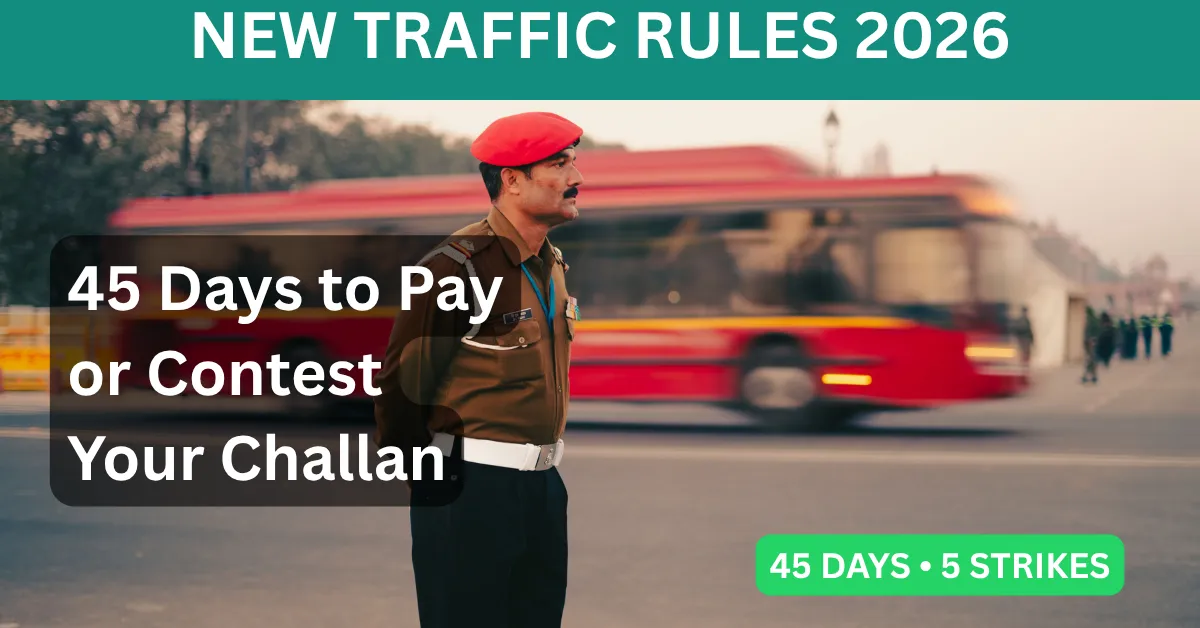
- Photo: “A traffic officer in a red beret stands in New Delhi, with a blurred red bus in the background” by ATUL Patel, Pexels photo 18681276 — pexels.com
Figures and dates in this article are as notified in the Gazette notifications cited above. States put the central rules into practice through their own officers and portals, and some move more slowly than others — if your state’s portal still shows the old process, ask your traffic police or transport department how they apply the 2026 rules. The amount on your challan is the amount that applies to you.
WRITTEN BY

Manish is the content curator at OnlineChallanChecker.com, a trusted platform for checking challan status, payment updates, and traffic fine information across India. With over 5 years of experience in digital content creation and online service platforms, Admin is committed to delivering accurate, easy-to-understand guides that help users manage their challans effortlessly.
Pingback: Mobile Phone While Driving Fine in India (2026)