
Quick Answer: mobile phone while driving fine — in India it is ₹5,000 for a first offence on the challan (Delhi’s compounding amount) and ₹10,000 for a repeat offence, under Section 184 of the Motor Vehicles Act, which treats using a handheld phone while driving as dangerous driving. The statute itself sets a range for a first offence — a fine of ₹1,000 to ₹5,000, and/or imprisonment of 6 months to 1 year — and ₹10,000 and/or up to 2 years for a repeat offence within 3 years. Driving without a licence is a separate offence under Section 181: a fine of ₹5,000 and/or imprisonment up to 3 months, with no higher repeat figure. Both challans can usually be paid online on the Parivahan portal within the 45-day payment window — if yours is marked as a court challan, you pay it in Virtual Court instead.
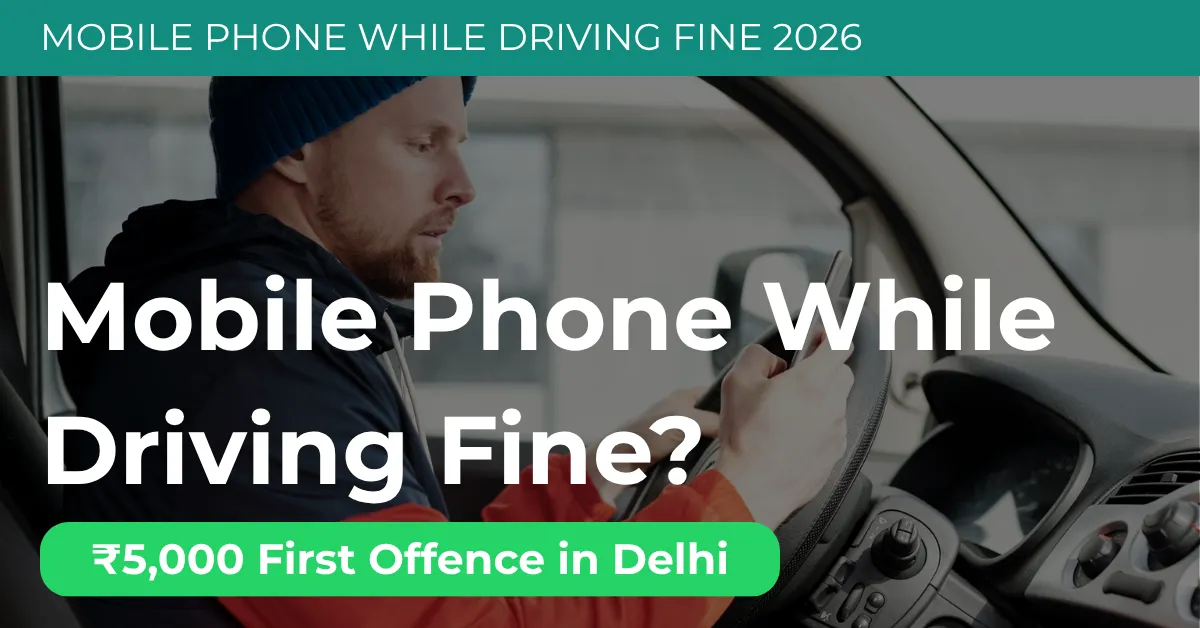
Photo: Norma Mortenson / Pexels — a distracted driver using a smartphone in a car; generic illustration, not a photo of an actual challan or enforcement stop.
Photo: Norma Mortenson / Pexels — a distracted driver using a smartphone in a car; generic illustration, not a photo of an actual challan or enforcement stop.
You were on your phone behind the wheel — or you were stopped without a licence — and now there is a challan with your name on it. The two questions that matter are simple: how much is it, and can I just pay it online? The answers you will find by searching are a mess. Some guides say the phone fine is ₹1,000, some say ₹5,000, some say ₹10,000, and several cite the wrong section of the law altogether. They cannot all be right, and the reason they disagree is that there are two different numbers for the same offence: what the statute allows, and what the challan in your hand actually says.
This guide gives you both numbers for both offences, the correct section for each, whether each challan can be paid online or has to go to court, and the exact steps to check and pay it. Every figure below is anchored to the law as it stands after the Jan Vishwas amendments of 2026 — and where the law and the challan disagree, this guide says which one you actually pay.
Mobile Phone While Driving Fine — First Offence vs Repeat Offence
The fine for using a mobile phone while driving is ₹5,000 for a first offence and ₹10,000 for a repeat offence — those are the amounts printed on the challan in Delhi, and the amounts most Indian guides quote. But they are not the whole story, because the statute behind them sets a range, not a single figure. Here is the full picture.
| First offence | Repeat offence | |
|---|---|---|
| What the challan shows (Delhi) | ₹5,000 | ₹10,000 |
| What the statute allows (Sec. 184) | Fine of ₹1,000 to ₹5,000, and/or imprisonment of 6 months to 1 year | Fine of ₹10,000, and/or imprisonment up to 2 years |
| Section | Section 184, Motor Vehicles Act, 1988 (dangerous driving) | |
The law works like this. Section 184 punishes driving “in a manner which is dangerous to the public”. The 2019 Amendment added an Explanation to that section, and clause (c) of the Explanation says that “use of handheld communications devices while driving” shall amount to driving dangerously. So holding your phone and using it while driving is not a small standalone offence with its own section — it is dangerous driving under Section 184, and it carries Section 184’s punishment: for a first offence, imprisonment of not less than six months and up to one year, or a fine of not less than ₹1,000 and up to ₹5,000, or both; for a second or subsequent offence committed within three years of a previous similar offence, imprisonment up to two years, or a fine of ₹10,000, or both.
Why does the challan then say a flat ₹5,000? Because most challans are not court sentences — they are compounded amounts, fixed by the state under Section 200 of the Act so the offence can be settled on the spot instead of going to court. The Delhi Traffic Police’s published penalty chart lists “Use of Hand-Held Communication Devices While Driving” under Section 184 at ₹5,000 for a first violation and ₹10,000 for a subsequent one. That is the figure you actually pay in Delhi, and it is also the figure quoted by the national guides that read the same chart. Outside Delhi, states can notify their own compounding amounts under Section 200, so the amount printed on your challan is the amount that counts for you — but the ₹1,000–₹5,000 statutory range is the ceiling and floor the state is working inside.
Two things follow from that. First, the repeat figure only bites if the second offence happens within three years of the first similar offence — that three-year window is written into Section 184 itself. Second, the jail terms in the table are what a court can impose; a compounded challan paid online is a fine, not a jail sentence. The jail part matters if the matter goes to court — which is why you should not ignore the challan and let the window lapse.
A common mistake: the phone fine is NOT Section 194D
If you search for this fine, you will find guides citing Section 194D for mobile-phone use. Our own status guide’s table lists the phone under Section 184 at ₹5,000 — the section is right; ₹5,000 is Delhi’s compounding amount, not the full statutory range. Section 194D is the helmet section — its heading in the Act is “Penalty for not wearing protective headgear”, and the fine for riding without a helmet is ₹1,000 plus a three-month disqualification. The phone belongs to Section 184, and the helmet belongs to Section 194D. If a guide tells you the phone fine is under 194D, it has mixed up two different offences — and you should not trust its other figures either. The Jan Vishwas amendments of 2026 did not change this: they only reworded Section 194D from “punishable with a fine” to “liable for a penalty”, leaving the ₹1,000 helmet amount exactly as it was.
Driving Without Licence Fine — Section 181
Driving without a licence is a separate offence with a simpler fine: ₹5,000, and/or imprisonment up to 3 months, under Section 181 of the Motor Vehicles Act. Section 3 of the Act says no person may drive a motor vehicle in a public place unless they hold an effective driving licence for that class of vehicle; Section 181 is the punishment for breaking that rule.
| Offence | Section | Fine | Imprisonment |
|---|---|---|---|
| Driving without a licence (never had one, or driving a class of vehicle your licence does not cover) | 181 | ₹5,000 | Up to 3 months, or both |
| Driving on an expired licence (after the 30-day grace — see below) | 181 | ₹5,000 | Up to 3 months, or both |
| Driving while disqualified from holding a licence | 182(1) | Fine of ₹10,000 | Imprisonment up to 3 months, or both |
Unlike the phone fine, there is no higher repeat figure in Section 181 — the same ₹5,000 and/or up to 3 months applies every time you are caught. And unlike the phone fine, the ₹5,000 in Section 181 is a flat figure, not a range — the Act says “fine of five thousand rupees” — and the Delhi chart and the national guides agree on ₹5,000 as the challan amount.
Three situations people constantly confuse are worth separating:
You never had a licence. That is the straightforward Section 181 case — ₹5,000 and/or up to 3 months. If the driver is a minor, the parent or guardian is liable instead under Section 199A: a fine of ₹25,000 and imprisonment up to 3 years, and the vehicle’s registration is cancelled for 12 months.
Your licence expired. Since 15 August 2026, a driving licence stays effective for 30 days after it expires — the Jan Vishwas Act re-inserted that proviso into Section 14 of the Act. Driving inside those 30 days is driving on a valid licence, and there is no Section 181 fine at all. After the 30 days, driving on it is driving without a valid licence, and the ₹5,000 applies. Renew before the expiry date anyway; the grace period is a safety net for a renewal that slips, not a reason to let a licence lapse. The full 30-day licence grace is explained in our 45-day payment rule guide.
You have a licence but did not have it with you. Section 130 of the Act requires you to produce your licence and other documents when an authorised officer demands them. Whether an officer will let you produce a valid licence later, or will issue a challan on the spot, depends on the officer and the state — no single all-India rule for this was verified for this article, so do not assume you can talk your way out of it. The practical fix costs nothing: keep your licence in DigiLocker or the mParivahan app, where it is accepted as a valid digital copy, so “left it at home” stops being a problem.
Did the Jan Vishwas Act 2026 Change These Fines?
Short answer: no — not these two. The Jan Vishwas (Amendment of Provisions) Act, 2026 (Act 8 of 2026, published in the Gazette of India on 8 April 2026 as CG-DL-E-08042026-271642) rewrote several Motor Vehicles Act fines, and it came into force for the Motor Vehicles Act on 15 August 2026. But its Motor Vehicles entry — serial number 51 of the Schedule — contains no clause amending Section 181 or Section 184 at all. The only mention of Section 184 in the whole entry is a list of compoundable offences, which confirms that handheld-device use under the Explanation to Section 184 can be compounded and settled without going to court.
What the Act did change, so you can see the check was actually done: driving without insurance (Section 196) went from ₹2,000 and/or up to 3 months’ imprisonment (₹4,000 on a repeat offence) to a penalty of three times the base premium or ₹5,000, whichever is higher, for a first contravention, and five times the base premium or ₹10,000, whichever is higher, for a subsequent one, with no jail term. Several minor offences — including the helmet and seat-belt sections — were reworded from “punishable with a fine” to “liable for a penalty” without changing their amounts. And a first contravention of the general-penalty sections now draws a recorded warning instead of a fine. None of that touches the phone fine or the no-licence fine, which is why the 2019 figures for Sections 184 and 181 are still the current figures in November 2026. Last reviewed: 20 November 2026. Always confirm with the official portal or your court.
Can You Pay These Challans Online?
Yes, usually — and that is the practical difference between these two offences and the ones that must go to court. Both Section 181 and the handheld-device clause of Section 184 are in the list of offences that can be compounded under Section 200 of the Act, which is what lets a challan be settled by paying a fixed amount instead of appearing before a magistrate. A compounded challan can normally be paid online on the Parivahan e-Challan portal, and the steps are the same as for any other challan.
In brief, the payment route is: find the challan on the Parivahan portal at echallan.parivahan.gov.in by challan number, vehicle number or driving licence number, check the offence, section, date and amount shown, click “Pay Now”, and pay by UPI, card or net banking — then download and keep the receipt. The full step-by-step method, including what to do when a challan does not show up, is in our step-by-step guide to checking your e-challan status online, and this article deliberately does not repeat those method sections.
One honest limitation: the Parivahan portal pages did not load when this article was written, so no live portal screen was seen. The steps above rest on our status guide, which was verified live, and on several independent guides that agree on them. If the portal shows a different amount from the figures in this article, pay the amount the portal shows for your challan — the portal is the record that counts.
There are two exceptions to “pay it online”. First, if your challan is marked as a court challan, the fixed compounding amount does not apply and the court decides the fine within the limits of the Act. In Delhi, general dangerous driving is listed as a court challan even though handheld-device use specifically has a fixed ₹5,000/₹10,000 amount — so read what your own challan says. A court challan is paid or contested in Virtual Court, not on the Parivahan payment page; our guide to paying a challan in Virtual Court covers the full steps. Second, if the 45-day payment window has already lapsed, the challan may have moved to court already — see the next section.
What Happens If You Do Not Pay — the 45-Day Window
Both of these challans are governed by the same payment deadline as every other e-challan: 45 days from the date the challan is issued to pay it or contest it online, under the amended Central Motor Vehicles Rules (G.S.R. 48(E), in force 21 January 2026). If you do nothing in those 45 days the challan is treated as accepted and you get a further 30 days to pay. After the window lapses, the challan can move to court — it does not move there automatically, and there is no automatic transfer to a Virtual Court at 90 days. The full timeline, with a worked example and the licence-grace rule that people constantly mix up with it, is in our 45-day rule guide, and this article does not re-explain it in full.
Once a challan has moved to court, you pay it on the Virtual Court portal (vcourts.gov.in), not on Parivahan — see our Virtual Court guide. And if the challan is old and long-pending, a Lok Adalat settlement may reduce the amount you have to pay at all — fines are often reduced there, though no fixed discount exists and the bench decides. The next National Lok Adalat is on Saturday, 12 December 2026 (the national date — a few states hold their sitting on a different day, so confirm your state’s date with your State Legal Services Authority). Our Lok Adalat guide for traffic challans and our Lok Adalat traffic challan settlement guide explain eligibility, the settlement process and the dates. What you should not do is ignore the challan: under the Supreme Court’s September 2026 order in the road-safety case, an unpaid challan can now stop you selling the vehicle, renewing its RC or getting a PUC certificate.
If you paid and the money was deducted but the challan still shows as pending, do not pay a second time — that is a failed-payment problem, not a second fine. Our guide to a failed e-challan payment with money deducted covers what to check and how to get it corrected.
How to Avoid These Two Fines
Both fines are avoidable for free, which is more than can be said for most traffic fines. For the phone: put it on silent and out of reach before you start driving — in the glove box, in your bag, anywhere your hand cannot reach it without thinking. If you need navigation, set it before you move and use voice directions; a phone in a dashboard mount showing a map is not the same thing as a phone in your hand, and the offence is specifically about handheld use. If a call cannot wait, pull over somewhere you are allowed to stop and take it there. Hands-free calling through Bluetooth or the car’s own system is not what Section 184 targets — but handling the phone to start that call is, so set it up before you drive.
For the licence: renew before the expiry date, and set a reminder a month ahead — the renewal itself is quick on the Parivahan portal, and the 30-day grace after expiry is a safety net, not a plan. If you are learning to drive, do not drive alone on a learner’s licence: a learner’s licence only lets you drive with a licensed driver beside you, and driving alone on it is driving without a valid licence. And check that your licence covers the class of vehicle you are driving — a licence for a two-wheeler does not authorise you to drive a car, and Section 181 covers that too. The 2026 rule changes, including the Jan Vishwas amendments and the 45-day rule, are summarised in our new traffic rules 2026 overview.
Mobile Phone While Driving Fine — FAQs
What is the fine for using a mobile phone while driving in India?
₹5,000 for a first offence and ₹10,000 for a repeat offence — those are the compounding amounts on the challan in Delhi, under Section 184 of the Motor Vehicles Act. The statute itself sets a range for a first offence (a fine of ₹1,000 to ₹5,000 and/or 6 months to 1 year in prison) and ₹10,000 and/or up to 2 years for a repeat offence within 3 years. The amount printed on your own challan is what you pay.
Which section is the mobile phone fine under — 184 or 194D?
Section 184. The 2019 Amendment’s Explanation (c) to Section 184 says that “use of handheld communications devices while driving” amounts to dangerous driving. Section 194D is the helmet section — the fine for riding without a helmet is ₹1,000 plus a three-month disqualification. Guides that cite 194D for the phone fine have mixed up the two offences.
What is the fine for driving without a licence in India?
₹5,000 and/or imprisonment up to 3 months, under Section 181 of the Motor Vehicles Act. There is no higher repeat figure — the same amount applies every time. If the driver is a minor, the parent or guardian is liable under Section 199A: a ₹25,000 fine and up to 3 years’ imprisonment, and the vehicle’s registration is cancelled for 12 months.
Can I pay a mobile phone challan online?
Usually, yes. Handheld-device use under the Explanation to Section 184 is compoundable under Section 200, so the challan can normally be paid on the Parivahan e-Challan portal — find it by challan, vehicle or licence number, check the amount, and pay by UPI, card or net banking. If your challan is marked as a court challan, pay it in Virtual Court instead. The full steps are in our status guide.
Can I pay a driving without licence challan online?
Usually, yes — Section 181 is also compoundable under Section 200, so the challan can normally be paid on the Parivahan portal in the same way. If it has already moved to court, pay it on the Virtual Court portal (vcourts.gov.in) instead. And if you have since got a licence, getting one now does not cancel a challan that was already issued — the offence was driving without one on that day.
Is using a phone on hands-free allowed while driving?
The offence is specifically about handheld use — holding the phone and using it while driving. Hands-free calling through Bluetooth or the car’s built-in system is not what Section 184 targets. But picking the phone up to dial, read a message or change a setting is handling it, and that is the offence — so set up navigation and calls before you start driving, and do not assume that being stopped at a red light makes it safe or legal.
What if I left my licence at home?
You are required to produce your licence when an authorised officer demands it (Section 130), and whether an officer will let you produce a valid licence later or will issue a challan on the spot depends on the officer and the state — no single all-India rule for this was verified for this article. The practical fix is to keep your licence in DigiLocker or the mParivahan app, where it is accepted as a valid digital copy.
What happens if I do not pay the fine in time?
You get 45 days from the issue date to pay or contest the challan, plus a further 30 days if it is treated as accepted — after the window lapses, the challan can move to court, where the fine is decided by the court within the limits of the Act. An unpaid challan can also block selling the vehicle, renewing its RC or getting a PUC certificate. The next National Lok Adalat is on Saturday, 12 December 2026 (the national date — a few states hold their sitting on a different day, so confirm your state’s date with your State Legal Services Authority). It is the nearest structured chance to settle an old challan for less. The full timeline is in our 45-day rule guide.
Sources
- Gazette of India, Extraordinary, Part II, Section 1, 8 April 2026 (CG-DL-E-08042026-271642) — Jan Vishwas (Amendment of Provisions) Act, 2026 (Act 8 of 2026), Schedule serial 51 (Motor Vehicles Act, 1988), clauses (A)–(ZS), read from the Gazette text 18 Nov 2026: no clause amends Sec. 181 or Sec. 184; clause (Z-I) rewords Sec. 194D only; clause (ZL) rewrites Sec. 196; clause (ZP) lists Expl. (c) to Sec. 184 among compoundable offences
- Signalpe — “Section 184 of the Motor Vehicles Act, 1988 — Driving dangerously” (2019 Amendment instruction quoted verbatim): signalpe.com
- Signalpe — “Section 181 of the Motor Vehicles Act, 1988 — Driving vehicles in contravention of section 3 or section 4” (2019 Amendment instruction quoted verbatim): signalpe.com
- Signalpe — “Jan Vishwas Act 2026: What Changed for Drivers on 15 August” (Sec. 181 and Sec. 184 unchanged; Sec. 194D reworded, ₹1,000 unchanged; S.O. 4100(E) 24 Jul 2026): signalpe.com
- Signalpe — “Traffic Fines in Delhi — Penalty List” (Delhi Traffic Police chart: handheld device Sec. 184 ₹5,000, repeat ₹10,000; driving without licence Sec. 181 ₹5,000; general dangerous driving a court challan): signalpe.com
- ChallanTimes — “Delhi Traffic Challan Rules Explained” (Delhi Traffic Police list: handheld device ₹5,000 first, ₹10,000 subsequent): challantimes.in
- Acko — “What Is Section 184 Of The Motor Vehicle Act?” (first offence fine ₹1,000–₹5,000, repeat ₹10,000 within 3 years): acko.com
- India Code — Motor Vehicles Act, 1988 (Sec. 194D: “Penalty for not wearing protective headgear”): indiacode.nic.in
- Central Motor Vehicles (Third Amendment) Rules, 2026, G.S.R. 48(E) of 20 January 2026, in force 21 January 2026 — 45-day payment window (via post 2284 and ET Auto, 23 Jan 2026)
- Parivahan — e-Challan portal (Ministry of Road Transport and Highways): echallan.parivahan.gov.in (did not load on 18 Nov 2026 — see text)
- Virtual Courts — traffic challan payments: vcourts.gov.in
- National Legal Services Authority (NALSA) — National Lok Adalat dates (next sitting Saturday, 12 December 2026): nalsa.gov.in
- Our guide: How to Check E-Challan Status Online — A Step-by-Step Guide 2026
- Our guide: E-Challan Payment Last Date: The 45-Day Rule & Grace Period (2026)
- Our guide: How to Pay Challan in Virtual Court: Step-by-Step Guide
- Our guide: E-Challan Payment Failed but Money Deducted? What to Do (2026 Guide)
- Our guide: How to Settle Traffic Challans via Lok Adalat in India 2026
- Our guide: Lok Adalat Traffic Challan Settlement 2026
- Our guide: New Traffic Rules 2026 India: E-Challan 45-Day Rule, 5-Strike Licence Rule & Jan Vishwas Changes
Note: This article is general information, not legal advice. The fine figures are the central amounts under the Motor Vehicles Act as amended in 2019 and the Jan Vishwas Act 2026; states can notify their own compounding amounts under Section 200, so the amount printed on your own challan and shown on the official portal is what you pay. Always confirm the section, amount and last date on your own challan before you pay.
Last updated: 18 November 2026
WRITTEN BY
Manish is the content curator at OnlineChallanChecker.com, a trusted platform for checking challan status, payment updates, and traffic fine information across India. With over 5 years of experience in digital content creation and online service platforms, he is committed to delivering accurate, easy-to-understand guides that help users manage their challans effortlessly.

Manish is the content curator at OnlineChallanChecker.com, a trusted platform for checking challan status, payment updates, and traffic fine information across India. With over 5 years of experience in digital content creation and online service platforms, Admin is committed to delivering accurate, easy-to-understand guides that help users manage their challans effortlessly.
Pingback: Driving Without Licence Fine in India (2026): ₹5,000, Jail, Owner Liability & How to Pay -