
If you drive in Uttarakhand, checking your Uttarakhand e-Challan regularly is one of the simplest ways to avoid surprises. A challan can be issued at a checkpoint, recorded by a camera, or noted by an officer with a handheld device, and you may not always receive a paper copy on the spot. This guide explains, in plain language, how to check the status, how to pay safely on the official portal, and what to do if a challan looks wrong.
✓ Fine rates on this page are verified from the Motor Vehicles (Amendment) Act, 2019 · Official portal: echallan.parivahan.gov.in · Updated November 2026
Contents
- What is Uttarakhand e-Challan
- How to Check Uttarakhand e-Challan Status Online
- How to Pay the Challan Online
- Check via Vahan and Parivahan Services
- How to Contest a Wrong Challan
- Common Traffic Violations in Uttarakhand
- Traffic Challan Fine Rates in Uttarakhand (2026 Chart)
- Settle Your Pending Challans in Lok Adalat in Uttarakhand
- What Happens If You Don’t Pay Your Uttarakhand e-Challan?
- Pay Your Uttarakhand e-Challan Offline
- Details You Need
- Uttarakhand-Specific Notes for Drivers
- e-Challan in Uttarakhand’s Major Cities
- Frequently Asked Questions
- Check e-Challan in Other States
- Conclusion
What is Uttarakhand e-Challan
An e-Challan is an electronic record of a traffic offence under the Motor Vehicles Act. Instead of relying only on a paper slip, the enforcing officer or camera system creates a digital challan that is linked to your vehicle registration number and, in many cases, to the driving licence of the person driving at the time. That record is stored in the central system, which is why you can search for it online.
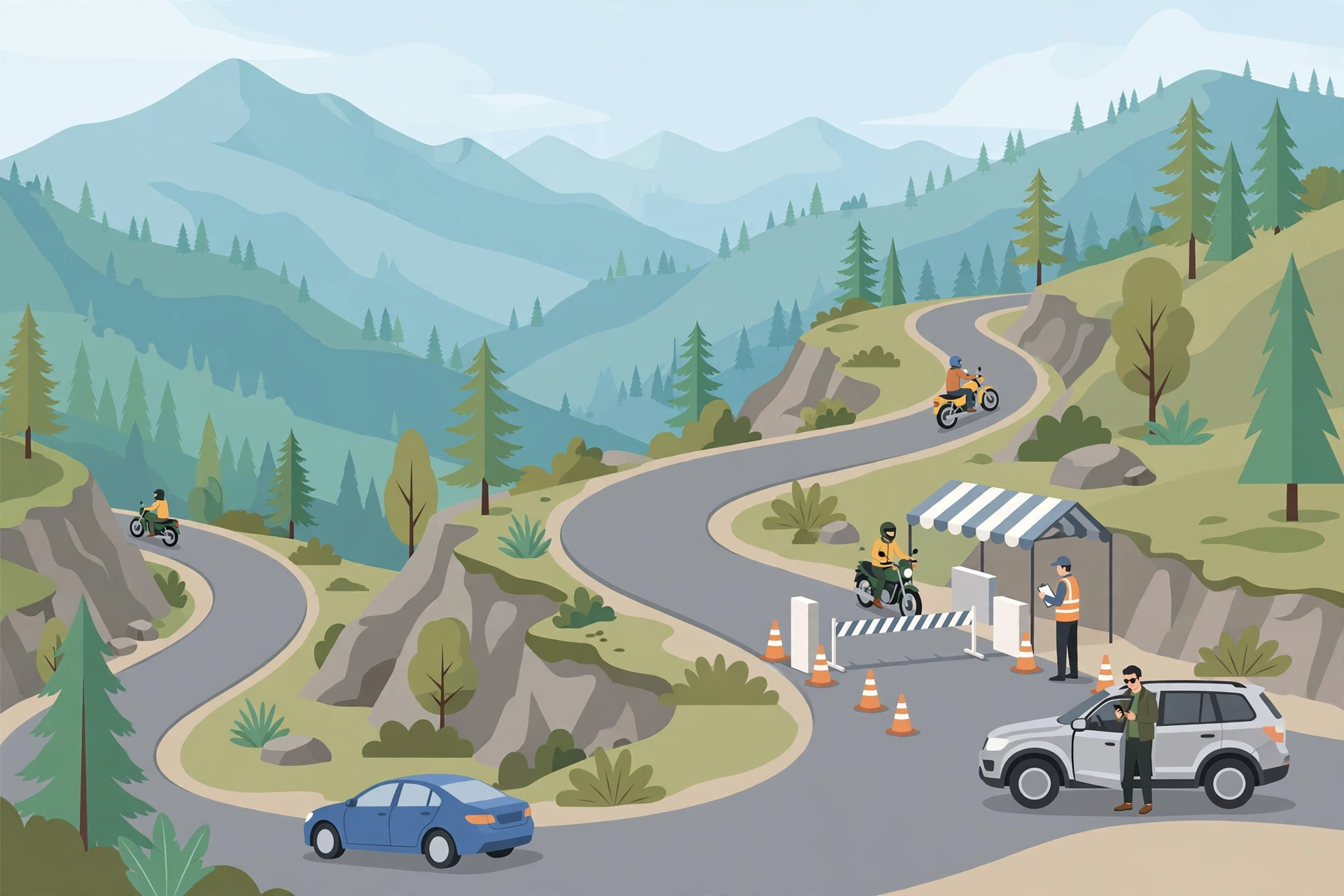
In Uttarakhand, challans are commonly issued for everyday offences such as overspeeding, riding without a helmet, driving without a seat belt, jumping a red light, using a mobile phone while driving, and parking in a no-parking area. On hill roads and highways, officers also pay close attention to overloaded vehicles, missing documents, and dangerous overtaking. The exact offence name and the legal section are shown on the challan itself, so always read those details before you pay.
For a broader overview that applies across India, see our complete step-by-step guide to checking e-Challan status online. That guide covers the national process, while this page focuses on what drivers in Uttarakhand need to know in practice.
How to Check Uttarakhand e-Challan Status Online
The safest way to check is through the national portal, because it draws from the central database and covers challans from across the country. Follow these steps carefully and make sure you are on the correct government website before you enter any details.
- Open the official Parivahan e-Challan portal at echallan.parivahan.gov.in in your browser. Check that the address ends with gov.in.
- On the homepage, look for the option to check challan status, usually labelled Check Challan Status under the online services menu.
- Choose how you want to search. You can search by vehicle number, by challan number, or by driving licence (DL) number. Vehicle number is the most common choice for owners.
- Enter the number exactly as it appears on your registration certificate or licence. For a vehicle search, type the registration number without extra spaces where possible.
- Complete the captcha shown on the screen and click Get Detail or the equivalent search button.
- If the portal asks for additional verification, follow the on-screen instructions. Some searches may ask for the last digits of the chassis or engine number, or send a one-time password to the registered mobile number.
- Review the list that appears. Each entry should show the challan number, date, offence, place, and amount, along with whether it is pending or paid.
- Click an individual challan to see fuller details and any supporting information available on the portal before you decide to pay or contest it.
How to Pay the Challan Online
Once you have found a pending challan and confirmed that the vehicle, offence and amount are correct, you can pay on the same official portal. Paying online is usually quicker than visiting an office, and you receive a digital record immediately.
- Find your challan on the official portal using the steps above.
- Open the challan detail and check the offence, date, location and amount one more time. If anything looks wrong, do not pay yet; see the contest section below.
- Click Pay Now or the payment option shown against that challan.
- You may be redirected to a payment gateway or a state payment page linked from the portal. Confirm that you arrived there from the official portal and that the amount matches.
- Choose a payment method. The portal generally offers UPI, net banking, and debit or credit card options, depending on the payment route for that challan.
- Complete the payment through your bank or UPI app. Do not refresh or close the page while the payment is processing.
- After a successful payment, wait for the confirmation screen. Note the transaction reference shown.
- Download and save the receipt. Keep a PDF or screenshot in your phone and email it to yourself as a backup.
- Check the challan status again after some time to confirm it now shows as paid. If the money was deducted but the status has not updated, keep the bank proof and use the portal’s pending transaction check before paying again.
Check via Vahan and Parivahan Services
Parivahan is the national platform of the Ministry of Road Transport and Highways for transport services. Two of its best-known databases support the challan system. Vahan holds vehicle registration information, and Sarathi holds driving licence information. When a challan is created, it connects to these records, which is why a simple vehicle number search can retrieve it.
The e-Challan portal is the main place to check and pay. The wider Parivahan Sewa website also links to related services such as vehicle registration details, licence services, and application status checks. The mParivahan mobile app, published by the official authorities, can also be useful for viewing digital documents and checking basic vehicle information, but for challan payment you should still follow the official portal flow and keep your receipt.
How to Contest a Wrong Challan
Mistakes do happen. A number plate may be misread by a camera, a challan may be issued for a vehicle you had already sold, or the photo evidence may show a different vehicle. If you believe a Uttarakhand e-Challan is wrong, do not ignore it, and do not pay it just to make it disappear if you genuinely dispute it, because payment can be treated as acceptance.
Start by collecting evidence. Save the challan details, note the date and time, and gather anything that supports your case, such as toll receipts, parking slips, GPS or trip records, sale documents for a transferred vehicle, or proof that you or the vehicle were elsewhere. If the portal shows an offence image, compare the plate and vehicle in the image carefully with yours.
Next, use the grievance or complaint option available on the official e-Challan portal, where it is offered for that challan, and explain the error clearly and briefly. Attach or keep ready the supporting documents. Note any complaint reference number you receive. In some cases, you may need to contact the traffic police unit or the transport authority in the district where the challan was issued, or attend the court mentioned on the challan if the matter has already been forwarded there.
Act promptly. The longer a disputed challan is left unattended, the more likely it is to be transferred to court, after which the online options may narrow. See our guide to settling traffic challans through Lok Adalat in India for eligible settlement sittings. Keep copies of everything you submit, and continue to check the status online until the record is corrected, settled, or formally decided.
Common Traffic Violations in Uttarakhand
The offences below are among those most commonly recorded across India, including in Uttarakhand. This section is general information only. Fines are set under the Motor Vehicles Act and applicable notifications, and they can differ by offence, vehicle type, and whether it is a repeat offence. The exact amount payable for your case is the amount shown against your challan on the official portal, so rely on that figure and not on any list on a private website, including this one.
- Overspeeding: Driving above the posted limit, especially risky on hill curves, near schools, and in town limits.
- Riding or driving without protective gear: Riding a two-wheeler without a helmet, or driving without a seat belt.
- Using a mobile phone while driving: Holding or operating a phone in a way that takes attention and control away from the road.
- Signal and sign violations: Jumping a red light, ignoring stop signs, or entering a no-entry road.
- Wrong parking: Parking in no-parking zones, on footpaths, or in a way that blocks traffic, ambulances or fire access.
- Document offences: Driving without a valid licence, registration, insurance, or pollution certificate where required. New drivers should understand the licence stages first; see our learning licence apply, fees, test and download guide.
- Overloading and passenger offences: Carrying more passengers or goods than permitted, a particular concern for commercial and tourist vehicles on hill routes.
- Driving under the influence: Alcohol or other intoxication cases are treated very seriously and can involve court proceedings rather than simple online payment.
Traffic Challan Fine Rates in Uttarakhand (2026 Chart)
The chart below lists the standard fines for the most common traffic offences in Uttarakhand under the Motor Vehicles (Amendment) Act, 2019, so you can see at a glance what an offence can cost before you check your own challan.
| Traffic Offence | Fine (First Offence) | MV Act Section |
|---|---|---|
| Riding without a helmet | ₹1,000 + licence disqualified for 3 months | Section 194D |
| Driving without a seat belt | ₹1,000 | Section 194B |
| Over-speeding (light motor vehicle / car) | ₹1,000–₹2,000 | Section 183 |
| Over-speeding (medium or heavy vehicle) | ₹2,000–₹4,000 | Section 183 |
| Dangerous driving, red-light jumping or using a mobile phone while driving | ₹1,000–₹5,000 | Section 184 |
| Drunk driving (first offence) | ₹10,000 and/or up to 6 months in jail | Section 185 |
| Driving without a driving licence | ₹5,000 | Section 181 |
| Driving without insurance | ₹2,000 (₹4,000 for a repeat offence) | Section 196 |
| Triple riding on a two-wheeler | ₹1,000 | Section 194C |
| Driving without a valid PUC certificate | ₹10,000 | Section 190(2) |
| Not giving way to an ambulance or fire vehicle | ₹10,000 | Section 194E |
| Other general traffic offences | ₹500 (₹1,500 for a repeat offence) | Section 177 |
Note on these amounts: These are the national penalties under the Motor Vehicles (Amendment) Act, 2019, which Uttarakhand applies. State governments can set their own compounding amounts within these limits, so the amount printed on your actual challan is the final amount that applies to you. You can confirm your exact challan amount on the official Parivahan e-Challan portal.
Settle Your Pending Challans in Lok Adalat in Uttarakhand
Pending traffic challans are often settled here for less than the full fine.
A Lok Adalat is a settlement sitting organised by the Legal Services Authorities under the Legal Services Authorities Act, 1987, where pending cases are resolved by mutual agreement instead of a long court process. Traffic challans that are compoundable — especially challans that have already been transferred to a court or are pending in the virtual court — can be taken up and settled on the spot. For minor offences, the matter is often settled for less than the full fine amount. Once a challan is settled in the Lok Adalat, the case is closed and the order passed is final and binding.
This route is most useful if you have old, unpaid Uttarakhand challans that are already pending in court. Serious or non-compoundable offences — for example, drunk driving cases that must be decided by a court — may not be taken up, and a challan that you have already paid cannot be refunded through a Lok Adalat. There is no fixed or guaranteed discount: the amount at which a challan is settled is decided by the bench at the sitting, based on the offence and the facts of the case.
Before the sitting, check your challan status on the official e-Challan Parivahan portal and note down any challans shown as transferred to court or pending in the virtual court. On the day, carry the challan details, your vehicle registration certificate (RC) and your driving licence. Confirm the exact date, venue and any token or registration requirement with your District Legal Services Authority or in the Uttarakhand State Legal Services Authority notice for this sitting. The Uttarakhand State Legal Services Authority has confirmed this sitting across the state, and applications can be submitted to the district authority in advance. For the full process, the documents to carry and what to expect on the day, read our step-by-step guide to settling traffic challans through Lok Adalat.
What Happens If You Don’t Pay Your Uttarakhand e-Challan?
A pending e-Challan does not disappear if you ignore it. It stays recorded against your vehicle and driving licence in the central system, and the longer it remains unpaid, the more likely it is to create problems the next time you need a vehicle-related service. It is almost always simpler to clear it early — by paying online, or by settling it at a Lok Adalat if it has already gone to court.
- If the challan is not paid in time, it can be transferred to the court or the virtual court, and you may receive a summons to appear.
- The total cost can grow, because a challan that reaches court can attract additional charges beyond the original fine.
- Vehicle services such as RC renewal, fitness renewal and ownership transfer can be blocked while challan dues remain pending.
- For repeated unpaid offences, action against the driving licence is also possible.
- The simple fix: pay online on the official portal, or settle the challan at a Lok Adalat if it is already pending in court.
Pay Your Uttarakhand e-Challan Offline
If you prefer to pay in person, you can pay a Uttarakhand e-Challan offline at the traffic police station or the transport (RTO) office connected with the challan; if the challan has already been transferred to court, it is settled through the court instead. Carry the challan number, your vehicle registration certificate (RC) and your driving licence with you. Always collect and keep the stamped payment receipt as proof, and note that an offline payment can take a few days to reflect in the online record, so keep the receipt safe until the status updates.
Details You Need
You do not need a large set of documents for a basic online check. In most cases, one of the three identifiers in the table below is enough to start, along with the captcha shown on the portal. Keep your registration certificate and licence handy so you can copy numbers accurately.
| Detail | Where it is used | Where to find it |
|---|---|---|
| Vehicle number (registration number) | To search for all challans linked to a vehicle; the most common search method for owners and buyers | Number plate, registration certificate (RC), insurance policy |
| Challan number | To verify and pay one specific challan, or to track a notice you already received | Challan notice, SMS or printout from the issuing officer, portal search result |
| Driving licence (DL) number | To search for challans linked to a driver, useful if you drive multiple vehicles | Your driving licence card or Sarathi record |
Uttarakhand-Specific Notes for Drivers
Uttarakhand’s transport services are handled through the state’s transport department and its regional and assistant regional transport offices, which work alongside the traffic police in districts across the state. Dehradun, as the capital and a busy administrative and education hub, sees dense city traffic, while pilgrim and tourist movement towards hill and Char Dham routes adds seasonal pressure on highways leading out of Haridwar and Rishikesh.
The capital of Uttarakhand is Dehradun, and major cities and towns where drivers commonly encounter checkpoints, camera enforcement and heavier traffic include Dehradun, Haridwar, Rishikesh, Haldwani, Roorkee, Nainital, Udham Singh Nagar. Tourist traffic, seasonal weather and hill driving add extra challenges in this state. In the hills, speed limits, hairpin bends, landslide-prone stretches in the rainy season, and fog or snow in winter in higher areas all demand slower, more careful driving than on plains highways. Many challans on tourist routes arise from hasty overtaking, wrong parking at viewpoints, and overloading of taxis and tempo travellers.
If you are visiting Uttarakhand from another state, your challan will still usually appear on the national portal, because the system is centralised. That also means a challan issued here can follow your vehicle record back home, so it is better to check and clear it promptly rather than assuming an out-of-state vehicle will not be traced. Commercial drivers should inform their owner or operator as soon as a challan is received, so payment or contesting can be handled within the available time.
In Uttarakhand, challans are issued by both traffic police officers and transport department (RTO/MVD) enforcement staff. Officers record offences during roadside checks, and the same enforcement teams also work through the central e-Challan system, so a challan can be raised against your vehicle through either route.
Many challans today are generated by cameras rather than by an officer stopping you. CCTV and ANPR (automatic number plate recognition) cameras at junctions and speed-detection cameras record the offence along with photographic evidence, and the system creates the challan against the vehicle registration number. This is why owners often receive a challan for an offence they were never stopped for.
Commercial and transport vehicle owners should take extra care: permits, fitness certificates and loading limits are checked strictly for transport vehicles, and overloading or an expired permit or fitness certificate commonly leads to a challan during routine checks. Keeping these documents current avoids most such fines.
e-Challan in Uttarakhand’s Major Cities
e-Challans are issued across Uttarakhand, and most searches come from its biggest cities, where traffic and camera enforcement are heaviest. Every challan, whether issued by an officer at a checkpoint or recorded by a camera, is stored in the same central system and linked to your vehicle number.
Most challan searches in Uttarakhand come from these cities:
- Dehradun
- Haridwar
- Haldwani
- Roorkee
- Rishikesh
There is no separate process per city: the same Parivahan check-and-pay steps in this guide work for challans from every city listed above — search by vehicle number, challan number or driving licence number, verify the details and pay online.
Camera-based (CCTV/ANPR) challans are most common in the capital and the largest cities, where cameras watch busy junctions and main roads, so vehicle owners there may receive a challan by SMS or post without ever being stopped.
Frequently Asked Questions
How can I check my Uttarakhand e-Challan by vehicle number?
Go to the official Parivahan e-Challan portal, choose Check Challan Status, select the vehicle number option, enter your registration number and the captcha, and click Get Detail. The portal will list pending and paid challans linked to that vehicle, if any.
What payment methods are accepted for online challan payment?
On the official portal’s payment route, you can generally pay by UPI, net banking, or a debit or credit card. The exact options shown can depend on the payment gateway linked to that challan. Always save the receipt after a successful payment.
How long do I have to pay an e-Challan?
Pay as soon as you can after verifying the challan. If a challan remains unpaid for a long period, it may be transferred to a court or virtual court, after which normal online payment may no longer be available. The challan record and any notice you receive are the best guide for your specific case.
What should I do if I paid but the challan still shows as pending?
Do not pay again immediately. Keep your bank proof and payment receipt, wait for the portal to sync, and use the pending transaction check on the official portal if available. If the status still does not update, raise the issue through the portal’s grievance route with your transaction reference.
Can I check a challan for a vehicle registered in another state?
Yes, in most cases. The e-Challan system is national and linked to Vahan records, so a challan issued in Uttarakhand for a vehicle registered elsewhere, and challans issued elsewhere for a Uttarakhand vehicle, can usually be found on the same portal.
Is this website an official government website for paying challans?
No. Online Challan Checker is a private guide website. We explain the process and link to the official portal, but checking and payment should be done only on official government portals such as echallan.parivahan.gov.in.
Can I settle my Uttarakhand e-Challan in a Lok Adalat?
Yes, if the challan is for a compoundable offence and is pending in court or in the virtual court. The next National Lok Adalat is scheduled for Saturday, 12 December 2026, and pending traffic challans are commonly taken up there and often settled for less than the full fine. Serious, non-compoundable offences may not be covered, so check your challan status on the official portal and confirm the date and venue with your District Legal Services Authority before you go.
What happens if I don’t pay my Uttarakhand e-Challan?
The challan stays recorded against your vehicle and driving licence, and if it remains unpaid it can be transferred to the court or virtual court, where you may be called to appear. Pending dues can also block services such as RC renewal and ownership transfer. It is simpler to pay online on the official portal, or to settle a court-pending challan at a Lok Adalat.
How long does an e-Challan take to appear online?
A challan usually appears on the portal within a few hours to a few days after the offence is recorded. Camera-based challans can take longer because the record has to be processed and uploaded by the issuing authority, so if you expect a challan but cannot see one yet, check again after a few days.
Can I sell or transfer my vehicle with pending challans?
Usually not smoothly. An ownership transfer is generally blocked or held up until the pending challans against the vehicle are cleared, because the dues are recorded against the vehicle itself. Clear all pending Uttarakhand e-Challans and keep the payment receipts before you start a transfer.
Check e-Challan in Other States
A challan issued anywhere in India is recorded against your vehicle number, so if you drive across state borders it is worth checking the other states you travel through as well:
- Tamil Nadu e-Challan
- West Bengal e-Challan
- Odisha e-Challan
- Jharkhand e-Challan
- Assam e-Challan
- Goa e-Challan
- Himachal Pradesh e-Challan
- Madhya Pradesh e-Challan
- Kerala e-Challan
- Karnataka e-Challan
Conclusion
Checking and paying a Uttarakhand e-Challan online takes only a few minutes when you use the official portal and keep your vehicle number, challan number or DL number ready. Make it a habit to check periodically, especially after long trips, after driving in another district or state, and before buying or selling a vehicle. Verify every detail before paying, save every receipt, and use the grievance or Lok Adalat routes promptly if a challan is wrong.
For more help, return to the Online Challan Checker homepage for state guides and transport explainers, and use the national guide linked earlier in this article for the all-India process. Safe driving remains the best saving of all: no fine, no points of worry, and no time lost in resolving a challan.
Last updated: November 2026
Disclaimer: This article is published by Online Challan Checker, a private guide website. It is not an official government website and is not affiliated with the Government of India, the Ministry of Road Transport and Highways, the Uttarakhand government, or any traffic police department. Information here is general guidance only and may change. Always verify challan details, amounts and procedures on official government portals, and pay only on official government portals.

Kapil Khatter is an editorial contributor at OnlineChallanChecker.com, covering e-Challan and traffic-rule guides for Punjab, Haryana, Himachal Pradesh and Uttarakhand. He tracks state transport department notifications closely and writes clear, step-by-step guides so readers always get current fine rates, challan procedures and Lok Adalat updates for northern India.