
Quick Answer: PMKVY apply online is done on the official Skill India Digital Hub — skillindiadigital.gov.in. PMKVY 4.0 gives you free skill training — the government pays the training centre, you pay nothing — in a trade of your choice, with a government-recognised NSQF certificate that appears in your DigiLocker after you pass the assessment. There is no cash reward for joining or finishing a course in the current version, whatever older guides or WhatsApp forwards promise. PMKVY 4.0 was due to end on 31 March 2026 and has been extended, though the exact new end date is disputed — see below. To apply: sign up on the Hub with your mobile number, pick a course and a centre near you, enrol, attend the classes, and take the final assessment.
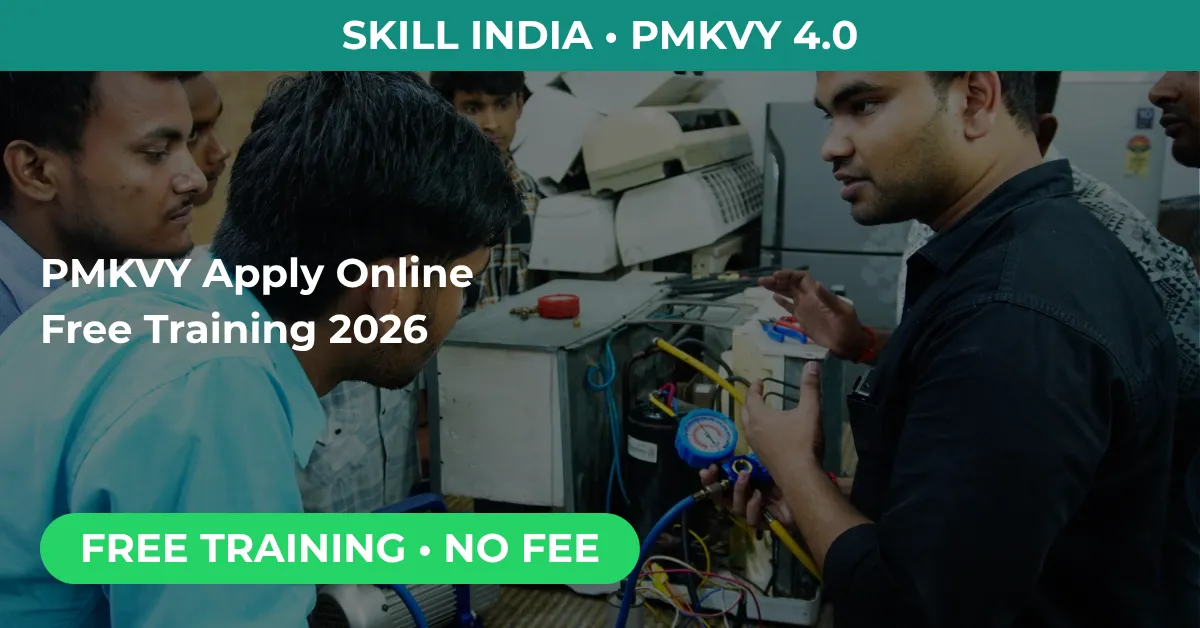
Photo: Multitech Institute / Pexels — generic photo of a hands-on AC repair training session in Delhi, not real PMKVY trainees.
If you are searching for PMKVY apply online, you are looking for free, government-paid skill training — and the good news is that the scheme is real, it is running right now, and registration is genuinely free. The bad news is that the guides around it are a mess: half still promise a cash reward that no longer exists, several quote a stipend of ₹8,000 that was never part of this version, and most repeat the same 31 December 2026 end date without checking it against what the ministry actually said. This guide gives you the straight picture: the exact registration steps, the courses actually on offer, who can apply, what you really get — and the two numbers every other guide gets wrong, with the official figures shown so you can check them yourself.
Last verified: 24 November 2026, against the Ministry of Skill Development & Entrepreneurship, NSDC and Press Information Bureau pages listed in Sources. The Skill India Digital Hub portal (skillindiadigital.gov.in) was confirmed live on 24 November 2026, but its registration flow could not be read from the fetched page, so the step labels below are as described in the scheme guides cited and should be re-checked live before you act on them. Scheme dates and course lists change — always confirm the current position on the official portal before you enrol.
What Is PMKVY 4.0?
PMKVY — the Pradhan Mantri Kaushal Vikas Yojana — is the Government of India’s flagship short-term skill-training scheme, launched by the Prime Minister on 15 July 2015, World Youth Skills Day. It is run by the Ministry of Skill Development & Entrepreneurship (MSDE) through the National Skill Development Corporation (NSDC). The idea is simple: if you are young and out of work, or you left school or college without a trade, the government pays a training centre to teach you one — and at the end you get a certificate that employers recognise, because it is aligned to the National Skills Qualifications Framework (NSQF) rather than being a private centre’s own paper.
The version running today is PMKVY 4.0, launched in 2023 after being announced in the Union Budget 2023 — the fourth version of the scheme (1.0 ran in 2015-16, 2.0 from 2016 to 2020, 3.0 from 2020 to 2022). It is built around what industry wants now: demand-driven courses, real workplace exposure through On-the-Job Training, and new-age subjects — artificial intelligence, drones, 5G, green hydrogen, cybersecurity — alongside traditional trades like electrician, beautician, tailor and retail. In February 2025 the Union Cabinet folded PMKVY 4.0 together with the apprenticeship scheme (PM-NAPS) and the Jan Shikshan Sansthan scheme into one composite programme, the Skill India Programme, with a total outlay of ₹8,800 crore for 2022-23 to 2025-26.
| Detail | PMKVY 4.0 |
|---|---|
| Run by | Ministry of Skill Development & Entrepreneurship (MSDE), implemented by NSDC |
| Launched | 15 July 2015 (scheme); 4.0 phase launched 2023 |
| Cost to you | Free — training, assessment and certification paid by the government |
| Certificate | NSQF-aligned, digitally verifiable, issued on DigiLocker / Skill India Digital profile |
| Age band | 15–59 years (scheme’s target age band; individual courses may set their own limits) |
| Registration | Skill India Digital Hub — skillindiadigital.gov.in |
| Current status | Running; extended beyond its original 31 March 2026 end (exact end date disputed — see below) |
PMKVY Apply Online — Step by Step
There is exactly one official place to register: the Skill India Digital Hub (SIDH) at skillindiadigital.gov.in. The old PMKVY portal, pmkvyofficial.org, no longer works — any site or agent still sending you there is working from stale information. Do not pay anyone to register you; registration is free, and a centre that asks for a “registration fee”, “kit fee” or “assessment fee” is breaking the scheme’s own rules. Here is the process:
- Open the Skill India Digital Hub at skillindiadigital.gov.in, or download the Skill India Digital Hub app from the Play Store or App Store. Use only this address — do not enter your Aadhaar number or mobile OTP on any other website that claims to register you for PMKVY.
- Register. Click “REGISTER” in the top menu, choose “Learner/Participant”, enter your 10-digit mobile number and email address, tick the terms-and-conditions checkbox and click “CONTINUE” — you will verify the mobile number with an OTP during registration. Then fill in your profile: name, date of birth, gender, district, education and Aadhaar details.
- Browse the courses. Open “Skill Courses” and filter by sector and job role. Each listing shows the NSQF level, the training hours, the entry qualification and the training centres near you that offer it.
- Pick a job role that fits your goal, not just its name. Check the entry qualification (most roles ask for 5th, 8th or 10th pass; some want ITI, a diploma or a degree), the NSQF level (levels 3–4 are entry-level jobs, levels 5–7 are supervisory or specialist roles) and the centre’s own record — visit the centre if you can, and ask to speak to candidates from the last batch.
- Enrol. On the Hub, choose your centre and batch start date and submit your enrolment — the centre will call you to confirm. You can also walk into a Pradhan Mantri Kaushal Kendra (PMKK) or any NSDC-affiliated training centre listed on the portal and enrol in person with your Aadhaar card, education certificate, photographs and bank passbook.
- Attend the training. Most short-term courses run 3 to 6 months, with 4–6 hours of class a day in a physical classroom (some digital roles run in a blended mode). Your attendance is recorded through Aadhaar-based biometric attendance (AEBAS) at the start and end of every session — without that record, your certificate is not released. Classes cover the trade itself, plus soft skills, digital literacy, financial literacy and an entrepreneurship orientation, and for many roles part of the hours are spent on On-the-Job Training at a real employer’s site.
- Take the assessment. An independent assessor from the relevant Sector Skill Council conducts the final assessment — a theory paper and a practical demonstration. The pass mark is typically 50–70% depending on the role, and the result is declared on the Hub within about 7–15 days. If you fail, a re-assessment is scheduled free of cost.
- Collect your certificate. On passing, your digital certificate is issued on the Hub and appears in your DigiLocker — a QR-coded, verifiable certificate, with a free printed certificate as well. Some sectors also issue a physical certificate signed by NSDC, the Sector Skill Council and MSDE.
- Use the placement support. Your centre is expected to help certified candidates find work — through job fairs (Rozgar Melas), employer tie-ups and your profile on the National Career Service (NCS) portal. There is no guaranteed government job, and no centre can promise you one.
Two warnings matter here. First, never share your Aadhaar OTP with a stranger on the phone — no official from the scheme will ever call you asking for it. Second, if a centre sits on your batch for months claiming “low enrolment”, or your result or certificate does not appear on the portal, escalate: first the centre head, then the training partner’s head office, then the relevant Sector Skill Council, and finally NSDC or the ministry’s grievance cell. The helplines listed in the guides are the NSDC training-partner helpdesk 1800-123-9626 and the Skill India helpline 8800-055-555 — both rest on scheme guides and should be re-checked on the official portal.
What Courses Can You Take Under PMKVY 4.0?
PMKVY 4.0 runs more than 600 courses across 30-plus sectors, and the new-age subjects are the headline change in this version: over 600 courses have been introduced in areas such as artificial intelligence, drone technology, 5G, solar energy, 3D printing, semiconductors and the Internet of Things — and as on 30 June 2026, more than 5.44 lakh candidates had been trained in these future-skills job roles. The ministry’s August 2026 reply in Parliament breaks the new-age catalogue down further:
| New-age area | Courses available |
|---|---|
| Artificial Intelligence & Machine Learning | 116 |
| Data Analytics | 80 |
| Cyber Security | 71 |
| Automation & Robotic Processing | 54 |
| Green Skills | 99 |
| Drone Technology | 17 |
That is the new-age end of the catalogue. The bulk of enrolments are still in the traditional trades, and the full list runs across sectors such as these:
| Sector | Example job roles |
|---|---|
| IT & IT-enabled services | Data entry operator, AI data quality analyst, web developer, computer operator |
| Electronics & hardware | Mobile phone repair technician, AC and refrigeration technician, CCTV installation technician |
| Construction | Mason, electrician, plumber, welder |
| Healthcare | General duty assistant, home health aide, phlebotomist |
| Beauty & wellness | Beautician, hair stylist, beauty therapist |
| Apparel & textiles | Tailor, sewing machine operator, fashion designer assistant |
| Retail & sales | Retail sales associate, customer care executive |
| Agriculture & green jobs | Solar panel technician, organic farming assistant, drone operator for agriculture |
Three practical points about choosing. First, the course list on the portal is the only list that matters — a role a blog lists may have no live batch in your district, and a role no blog mentions may be running at the centre down your road. Second, the scheme has introduced short micro-credential courses of 7.5 to 30 hours — bite-sized certificates for one specific skill, useful if you already work and want to add a single capability rather than a full 3–6 month course. Third, training is also delivered through Skill Hubs in schools and colleges — IITs, NITs, Jawahar Navodaya Vidyalayas, Kendriya Vidyalayas, Sainik Schools, Eklavya Model Residential Schools and PM Shri Schools — so a course may run in the evening at a school near you. And if you are studying alongside training, our NSP scholarship guide explains how to apply for a scholarship in the same year.
The Three Tracks: Short-Term Training, RPL and Special Projects
PMKVY 4.0 has three tracks — which one fits you depends on whether you are learning a trade from scratch, already know one, or belong to a group the regular centres do not reach:
| Track | Who it is for | How long | What happens |
|---|---|---|---|
| Short-Term Training (STT) | School/college dropouts and unemployed youth learning a fresh skill | 300–600 hours (about 3–6 months) | Classroom training at an accredited centre, with On-the-Job Training built in, then a third-party assessment and NSQF certificate |
| Recognition of Prior Learning (RPL) | Workers who already know a trade from years of work but have no certificate — carpenters, masons, beauticians, drivers, mobile-repair technicians | A short bridging/orientation course (12–80 hours, depending on the role) plus assessment | Your existing skill is assessed and certified; you can also take extra coursework to certify at a higher level. 3,32,137 candidates had been certified under RPL as on 30 June 2026 |
| Special Projects | Marginalised and vulnerable groups, difficult geographies, and specialised job roles outside the regular courses | Custom durations; can be residential | Project-based training with exemptions approved by the scheme’s Executive Committee — for example, training in prisons, for victims of trafficking, or in remote and tribal areas |
RPL deserves a second look, because it is the track most working people miss. If you have been repairing mobiles, cutting hair, laying bricks or driving for years without any paper to prove it, you do not need a six-month course — RPL certifies the skill you already have, usually after a short bridging course and an assessment. The certificate is the same NSQF-aligned certificate an STT candidate gets, and it turns informal work into a formal qualification an employer can check.
Who Can Apply for PMKVY 4.0?
Eligibility is deliberately wide — the scheme is meant for people the formal education system left behind as much as for fresh school-leavers. The conditions, as the scheme’s own framework sets them out, are:
- Indian citizen.
- Age 15 to 59 years — the scheme’s target age band. Note that some guideline summaries put short-term training at 15–45, and some job roles require you to be 18 or older (driving, security, electrical work, for example), so check the listing for the role you want rather than assuming the band applies to every course.
- School or college dropout, out-of-school youth, or unemployed — the scheme is aimed at people who need a first skill or a new one, not at people already in regular formal training for the same role.
- You meet the entry qualification of the job role — typically 5th, 8th or 10th pass for most trades; some roles ask for ITI, a diploma or a degree.
- You are not already enrolled in another PMKVY programme for the same period.
There is no income ceiling and no caste or category condition for the main short-term training track. Women are a large share of who it reaches: nearly 45% of PMKVY beneficiaries are women, according to the government’s own factsheet. If you are a woman trainee, our PMMVY guide covers the maternity benefit scheme, and our PM SVANidhi guide covers the loan for street vendors — both useful if you plan to turn a new skill into your own small business after training.
Keep these documents ready before you enrol: your Aadhaar card (needed for registration and biometric attendance), your education certificate for the entry qualification of your chosen role, passport-size photographs, and your bank passbook. If the centre asks for an income certificate, our income certificate guide explains how to get one from your own state’s portal — do not pay an agent for it.
What Do You Actually Get? Free Training, a Certificate — and No Cash Reward
This is the section where most other guides mislead you, so here it is plainly. What PMKVY 4.0 gives you:
- Free training. The course costs you nothing. The government pays the training centre — about ₹9,540 per candidate for a 300-hour course under the scheme’s cost norms — so the centre has no reason to charge you, and no right to.
- Free assessment and certification. The final assessment and the certificate are both free, with one free re-assessment if you fail the first time.
- A free uniform and induction kit — a T-shirt or jacket and a bag, with the participant handbook.
- A QR-coded digital certificate on DigiLocker, verifiable by any employer, plus a free printed certificate — mapped to the NSQF and the National Credit Framework, so it counts as formal recognition of your skill.
- Accidental insurance cover for one year during the training period, for every candidate.
- Boarding and lodging support for residential training — for women, persons with disabilities, candidates from special areas and aspirational, border and tribal-dominated districts, and Special Projects participants.
- Conveyance support for women and persons with disabilities attending non-residential training.
- Extra support of ₹5,000 towards assistive devices, aids and appliances for candidates with disabilities.
- Placement assistance after certification — job fairs, employer tie-ups and your profile on the National Career Service portal, with post-certification tracking for a year.
And what it does not give you — the correction the rival pages still refuse to make. PMKVY 4.0 pays no lump-sum cash reward for finishing a course. Earlier versions did feature a monetary reward on certification, and that is where the claim comes from — but the reward was removed in the current design. The ₹8,000 figure in WhatsApp forwards and on several scheme blogs — sometimes called a “placement reward”, sometimes a “stipend” — does not exist in PMKVY 4.0. There is no payment for joining, attending or passing. The one real stipend nearby belongs to a different scheme: under the apprenticeship scheme PM-NAPS, an apprentice earns a stipend from the employer, and the government pays 25% of it, up to ₹1,500 a month, by direct bank transfer — and you only get it if you are actually taken on as an apprentice after your course. Any centre that promises you ₹8,000 for enrolling is either confused or selling you something. The deal is free training and a real certificate.
PMKVY 4.0 Extended — But Until When, Exactly?
PMKVY 4.0 was launched for the period 2022-23 to 2025-26, so it was due to end on 31 March 2026. It has been extended — every source agrees on that. What they do not agree on is the new end date, and since this is the most-repeated fact about the scheme right now, it is worth showing you the disagreement instead of hiding it:
| Source | What it says |
|---|---|
| Most scheme blogs (legalbabu.com, sarkariyojana.com, aimindia.in, yojanawale.com) | Extended till 31 December 2026, with a revised target of 3 crore youth and PMKVY 5.0 to follow in early 2027 |
| MSDE letter dated 9 July 2026, reported by skillcouncils.com | Implementation period extended till 31 March 2027; all training, assessment and certification must be completed by 28 February 2027 |
| Lok Sabha reply, 3 August 2026 (Unstarred Question No. 2523) | “The PMKVY 4.0 scheme is extended for two years beyond 31.3.2026“ |
Those three cannot all be right. The 31 December 2026 date is the one you will see everywhere, but it appears in scheme blogs only — no official release opened in this session states it, and it is contradicted by the ministry’s own letter of 9 July 2026, which puts the end at 31 March 2027 with training to finish by 28 February 2027. The Lok Sabha reply of 3 August 2026 points further still, to a two-year extension. The honest position is this: the scheme is running and has been extended beyond March 2026, but the final end date is not settled in the public record, and this page will need a refresh when the ministry clarifies it. If you want a PMKVY 4.0 seat, do not wait for a deadline nobody can confirm — enrol while batches are running, and check the Hub for the live position in your district rather than trusting any single date in any guide, including this one.
The same caution applies to “PMKVY 5.0 in early 2027”. That date comes from the same blogs — and when Parliament directly asked the ministry in August 2026 whether PMKVY 5.0 guidelines were being prepared, the reply mentioned only the extension of 4.0 and confirmed nothing about 5.0. Until the ministry announces it, treat 5.0 as unconfirmed.
How Many People Has PMKVY Actually Trained? The Numbers That Don’t Add Up
You will find three different trained-count figures quoted for PMKVY, and they cannot all be true. Here are the official figures, from the government’s factsheet of 14 August 2026:
| Version | Candidates trained |
|---|---|
| PMKVY 1.0 (2015–16) | 19.85 lakh |
| PMKVY 2.0 (2016–2020) | 1.10 crore |
| PMKVY 3.0 (2020–2022) | 7.37 lakh |
| PMKVY 4.0 (2022– ) | Over 28 lakh trained, more than 19.36 lakh certified |
| Total across all four versions | About 1.65 crore |
Now compare that with what the scheme blogs say: “2.1 crore youth already trained, 70% of a revised 3-crore target”. That 2.1 crore does not reconcile with the government’s own version-by-version figures, which add up to about 1.65 crore across all four versions. Part of the gap is probably definitional — the February 2025 Cabinet release counts more than 2.27 crore beneficiaries across all three schemes of the Skill India Programme (PMKVY plus the apprenticeship scheme plus Jan Shikshan Sansthan), and that combined figure gets misquoted as a PMKVY-only number. The “27.08 lakh” figure you may also see is close to the official “over 28 lakh” for PMKVY 4.0 and looks like an older count of the same thing. The figures this guide stands behind are the ones in the table above — and if a guide quotes you 2.1 crore or 3 crore without saying which version or which schemes it is counting, it has not done the arithmetic.
After the Certificate — Jobs, Apprenticeship or Your Own Work
A certificate on its own does not pay rent, so be realistic about what happens after you pass. PMKVY is a training scheme, not a job scheme — nobody in it can guarantee you a government job, and any centre that promises one is lying. What it does give you is three routes, depending on your trade:
- Wage employment. Your centre arranges job fairs and employer interviews, and your profile goes on the National Career Service portal. In the earlier versions, where placements were tracked, 1.11 crore candidates were certified under short-term training and 24.38 lakh were reported placed — roughly one in five. The certificate opens doors, but you still have to walk through the interview yourself.
- Apprenticeship. After your course you can move into an apprenticeship under PM-NAPS, where you earn while you learn — the employer pays the stipend and the government adds 25% of it, up to ₹1,500 a month, by direct bank transfer. Apprenticeships run 6 to 36 months and often convert into regular jobs.
- Self-employment. For trades like beautician, tailor, mobile repair or electrician, many candidates start their own micro-enterprise instead of looking for a job. PMKVY is formally linked to the schemes that fund that route — PM Vishwakarma for traditional artisan trades, and Mudra loans for micro-enterprises. If that is your plan, read our PM SVANidhi guide for the loan available to small vendors, and keep your certificate and training records — a lender will ask for proof of the skill you are borrowing against.
One more honest note: the certificate is valid for life, but the job role is not frozen in time. In fast-changing trades — IT, electronics, digital marketing — the skill you certify in today will need a refresher in three to five years, and the short micro-credential courses of 7.5 to 30 hours exist precisely so you can add a new skill without starting over.
Frauds and Mistakes to Avoid
Free government schemes attract middlemen, and PMKVY is no exception. The five traps that catch people:
- Anyone charging a fee. Registration, training, assessment and certification are all free. If a centre asks for a “registration fee”, “kit fee” or “assessment fee”, refuse and report it — it violates the scheme’s guidelines. The money flows from the government to the centre, never from you.
- The ₹8,000 message. A chain message promises ₹8,000 as a placement reward or stipend for joining PMKVY. There is no such payment in PMKVY 4.0 — the only stipend nearby is the apprenticeship stipend under PM-NAPS, paid to apprentices, not trainees.
- Fake portals and dead domains. The only portal is skillindiadigital.gov.in. The old pmkvyofficial.org no longer resolves, and any lookalike site asking for your Aadhaar number or OTP is a fraud. The scheme will never call you asking for an OTP.
- Agents who “guarantee” a certificate or a job. The certificate comes only from passing the Sector Skill Council’s assessment, and no agent can arrange that. A centre that guarantees a pass is telling you it will fake the assessment — and a certificate earned that way is worthless to an employer who checks it.
- Waiting for the “last date”. The end date of PMKVY 4.0 is genuinely disputed (see above). If you keep waiting for a confirmed last date, the batches in your district may already have filled. If a course you want is running near you, enrol now.
PMKVY Apply Online — FAQs
How can I apply for PMKVY online?
Go to the Skill India Digital Hub at skillindiadigital.gov.in, register from the top menu (“REGISTER”) with your mobile number and OTP, browse “Skill Courses”, pick a job role and a training centre near you, and submit your enrolment. You can also enrol in person at a Pradhan Mantri Kaushal Kendra or NSDC-affiliated centre — the full step-by-step process is in the registration section above.
Is PMKVY training really free?
Yes — for the candidate. The government pays the training centre (about ₹9,540 per candidate for a 300-hour course under the scheme’s cost norms), and the assessment and certificate are free too. If any centre asks you for money, it is breaking the scheme’s rules.
Do I get money for joining PMKVY?
No. There is no cash reward for joining, attending or finishing a PMKVY 4.0 course — the lump-sum reward from earlier versions was removed, and the ₹8,000 “placement reward” message is false. The only stipend in this area is under the separate apprenticeship scheme PM-NAPS, where the government pays 25% of an apprentice’s stipend, up to ₹1,500 a month.
What certificate do I get after PMKVY training?
An NSQF-aligned certificate issued after a third-party assessment by the relevant Sector Skill Council — a QR-coded digital certificate that appears in your DigiLocker and on your Skill India Digital profile, plus a free printed certificate. It is valid for life, though fast-changing trades need a refresher every few years.
Who is eligible for PMKVY 4.0?
Any Indian citizen aged 15 to 59 years who meets the entry qualification of the chosen job role — usually 5th, 8th or 10th pass, though some roles need ITI, a diploma or a degree, and some need you to be 18 or older. It is aimed at school/college dropouts, out-of-school youth and unemployed people, and you must not already be enrolled in another PMKVY programme.
How long does PMKVY training take?
Short-Term Training runs 300–600 hours, usually 3 to 6 months with 4–6 hours of class a day, including On-the-Job Training. RPL certification for experienced workers is much shorter — a bridging course of 12–80 hours plus the assessment. Short micro-credential courses of 7.5 to 30 hours also exist for single skills.
Is PMKVY 4.0 still running? What is the last date to apply?
Yes, it is running. It was due to end on 31 March 2026 and has been extended, but the new end date is disputed: scheme blogs say 31 December 2026, an MSDE letter of 9 July 2026 says 31 March 2027 (training to finish by 28 February 2027), and a Lok Sabha reply of 3 August 2026 speaks of a two-year extension beyond 31 March 2026. Do not plan around any single date — enrol while batches are running in your district.
Can I apply for PMKVY if I already have a skill but no certificate?
Yes — that is what Recognition of Prior Learning (RPL) is for. If you already work as a carpenter, mason, beautician, driver or mobile-repair technician, RPL assesses the skill you have and certifies it, usually after a short bridging course. 3,32,137 candidates had been certified under RPL as on 30 June 2026.
Sources
- National Skill Development Corporation (NSDC) — Pradhan Mantri Kaushal Vikas Yojana (PMKVY) scheme page: scheme launched 15 July 2015; PMKVY 4.0 launched 2023; free training, free assessment and certification, uniform and induction kit, boarding/lodging and conveyance support, ₹5,000 assistive-device support for PwDs, accidental insurance, AEBAS biometric attendance; STT 300–600 hours with mandatory OJT; RPL and Special Projects tracks (opened and read 24 Nov 2026): api1.nsdcindia.org/pradhan-mantri-kaushal-vikas-yojana
- Press Information Bureau — Cabinet approval: continuation and restructuring of the Skill India Programme till 2026, outlay ₹8,800 crore (7 Feb 2025, Release ID 2100845): PMKVY 4.0 through STT including Special Projects and RPL; target age 15–59; OJT integration; 400+ new courses on AI, 5G, cybersecurity, green hydrogen, drones; micro-credential courses 7.5–30 hours; Skill Hubs; certifications mapped to NSQF and integrated with DigiLocker and NCrF; PM-NAPS stipend 25% up to ₹1,500/month by DBT; more than 2.27 crore beneficiaries across the three schemes (opened and read 24 Nov 2026): pib.gov.in/PressReleseDetailm.aspx?PRID=2100845
- Press Information Bureau — PMKVY factsheet (14 Aug 2026, PRID 2299409): PMKVY 1.0: 19.85 lakh trained; 2.0: 1.10 crore; 3.0: 7.37 lakh; 4.0: over 28 lakh trained, more than 19.36 lakh certified; nearly 45% of beneficiaries are women (opened and read 24 Nov 2026): pib.gov.in/PressReleasePage.aspx?PRID=2299409
- Press Information Bureau — PMKVY 4.0 future-skills training (PRID 2298230): over 600 courses in AI, drone technology, 5G, solar energy, 3D printing, semiconductors and IoT; more than 5.44 lakh candidates trained in these sectors as on 30 June 2026; OJT incorporated into STT; ₹414.86 crore utilised for future-skills training as on 30.06.2026: pib.gov.in/PressReleasePage.aspx?PRID=2298230
- Daily Advent — “5 lakh+ candidates trained in AI, emerging technologies under PMKVY 4.0 since 2023, says Govt” (reporting the government’s Rajya Sabha reply: placements tracked under STT in PMKVY 1.0–3.0, 1.11 crore certified, 24.38 lakh reported placed): lite.dailyadvent.com/detail/3e2f9b64260729en_ng
- Government of India, Ministry of Skill Development & Entrepreneurship — Lok Sabha Unstarred Question No. 2523, answered 3 August 2026: PMKVY 4.0 implemented from FY 2022–23 through STT and RPL; 3,32,137 RPL certifications as on 30.06.2026; 116 AI/ML, 54 automation/robotics, 80 data analytics, 71 cyber security, 17 drone and 99 green-skills courses; school-to-skill convergence for youth aged 15–45; “The PMKVY 4.0 scheme is extended for two years beyond 31.3.2026” (opened and read 24 Nov 2026): sansad.in/getFile/lsapps/loksabhaquestions/annex/188/AU2523_KZWquZ.pdf
- SkillCouncils.com — PMKVY 4.0 Extended Till 31 March 2027: MSDE Issues Official Order (MSDE letter dated 9 July 2026 from the PMKVY Division to the CEO, NSDC; training, assessment and certification to be completed by 28 February 2027; signed by Santosh Kumar, Under Secretary) (opened and read 24 Nov 2026): skillcouncils.com/newsw-details.php?jid=469
- Right to Information Wiki — How to apply for PMKVY Skill India / PMKVY 4.0 (registration steps on the Skill India Digital Hub; no cash reward in the current version; ₹8,000 reward message false; pmkvyofficial.org dead; no enrolment fee; helplines 1800-123-9626 and 8800-055-555; page states its details were checked against MSDE and the Skill India Digital Hub, Aug 2026) (opened and read 24 Nov 2026): righttoinformation.wiki/apply-skill-india-pmkvy-2026
- Right to Information Wiki — Pradhan Mantri Kaushal Vikas Yojana PMKVY 4.0 (no lump-sum cash reward in the current version; certificate in DigiLocker; free training) (opened via search 24 Nov 2026): righttoinformation.wiki/yojana/pmkvy-skill-india
- SchemeWala — PM Kaushal Vikas Yojana 2026 (no guaranteed cash stipend for attending; stipend only via NAPS apprenticeship after the course; no guaranteed placement; DigiLocker certificate) (opened via search 24 Nov 2026): schemewala.com/scheme/pradhan-mantri-kaushal-vikas-yojana
- AlertsYojana — PMKVY 4.0 Short-Term Training (STT benefits as per scheme guidelines: free 300–600 hour training, OJT, induction kit up to ₹500, assessment payout ₹600, one free re-assessment, accidental insurance, QR-coded digital certificate via DigiLocker, average cost ₹9,540 per candidate for a 300-hour course) (opened via search 24 Nov 2026): alertsyojana.com/scheme/pmkvy-stt/
- Skill India Digital Hub (official portal — opened and confirmed live on 24 November 2026 in the review session, homepage and /pmkvy-dashboard both rendered; the registration flow itself could not be read from the fetched page, so the step labels rest on source 8 above and must be live-checked in a real browser at publish time): skillindiadigital.gov.in
- SarkariYojana.com — PMKVY 4.0 Registration Form 2026 (31 December 2026 extension and 3-crore target as reported by scheme blogs; cited for the conflict, not as a verified fact): sarkariyojana.com/pradhan-mantri-kaushal-vikas-yojana-pmkvy/
- Our guide: NSP Scholarship Apply Online 2026-27 — listed in the live post-sitemap checked 24 Nov 2026
- Our guide: Income Certificate Apply Online: Fee, Portals & Status — listed in the live post-sitemap checked 24 Nov 2026
- Our guide: Pradhan Mantri Matru Vandana Yojana Apply Online (PMMVY) — listed in the live post-sitemap checked 24 Nov 2026
- Our guide: PM SVANidhi Loan Apply Online — listed in the live post-sitemap checked 24 Nov 2026
Last verified: 24 November 2026.
Note: This article is general information, not legal advice. Scheme dates, course lists and procedures change over time — and the PMKVY 4.0 end date is currently reported differently in different places, as explained above — so always confirm the current position, the course list and the batch dates on the official portal (skillindiadigital.gov.in) or at your nearest training centre before acting on it. Never pay anyone to register you for PMKVY, and never share your Aadhaar number, bank details or OTP with anyone claiming to enrol you. The photograph is a generic stock photo of a training session in Delhi and does not show real PMKVY trainees.
WRITTEN BY
Manish is the content curator at OnlineChallanChecker.com, a trusted platform for checking challan status, payment updates, and traffic fine information across India. With over 5 years of experience in digital content creation and online service platforms, he is committed to delivering accurate, easy-to-understand guides that help users manage their challans effortlessly.
Manish is the content curator at OnlineChallanChecker.com, a trusted platform for checking challan status, payment updates, and traffic fine information across India. With over 5 years of experience in digital content creation and online service platforms, Admin is committed to delivering accurate, easy-to-understand guides that help users manage their challans effortlessly.