
Quick Answer: A vehicle insurance check at toll plaza is now live as an NHAI pilot at Delhi’s Mundka toll plaza (NH-344M / UER-II): when your vehicle crosses, the system checks your third-party insurance against the VAHAN database, and if it has expired, an automated SMS reaches your registered mobile within minutes — with your registration number, the toll-crossing time and the policy expiry date. It is a warning, not a fine: nothing is charged at the toll plaza. But driving without valid third-party insurance is still an offence under Section 196 of the Motor Vehicles Act, and since 15 August 2026 the penalty is three times your vehicle’s base third-party premium or ₹5,000, whichever is higher (five times or ₹10,000, whichever is higher, for a repeat). Check your own cover free on the VAHAN portal or the mParivahan app before your next highway trip. Last reviewed: 20 November 2026. Always confirm with the official portal or your court.
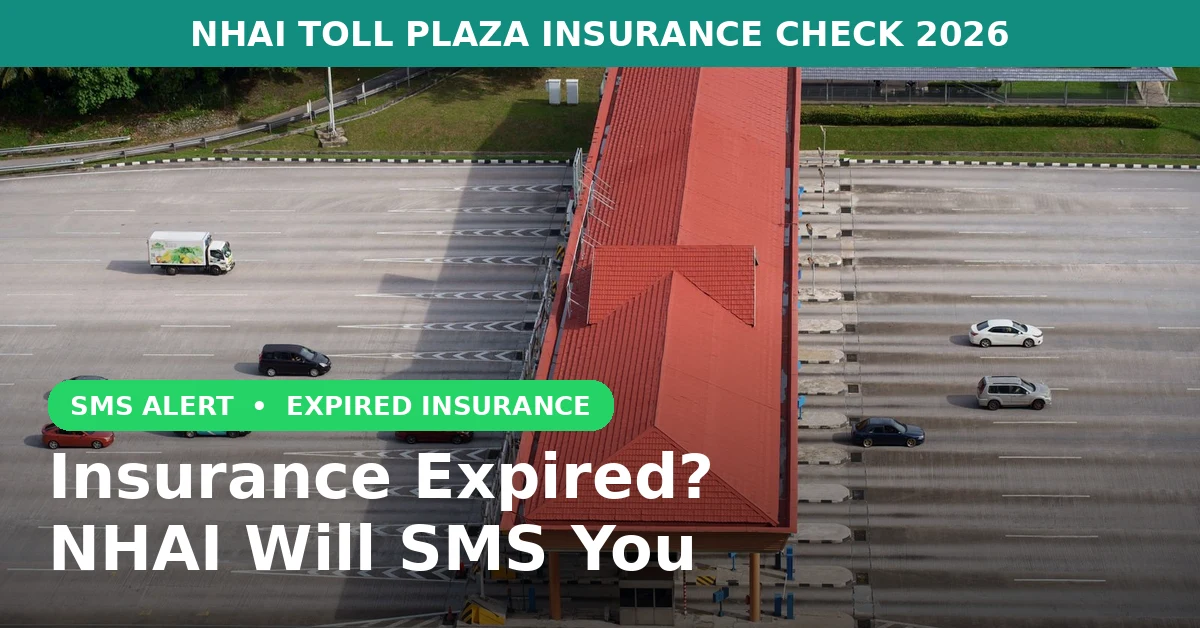
A vehicle insurance check at toll plaza sounds like something out of a science-fiction traffic system, but from 17 November 2026 it is real — at least at one toll plaza in Delhi. The National Highways Authority of India (NHAI) has started a pilot that quietly checks the insurance of every vehicle passing through the Mundka toll plaza and texts the owner if the third-party cover has lapsed. No policeman stops you, no barrier comes down, no fine is issued on the spot. The SMS is the whole point: a nudge to renew before a traffic policeman, a camera challan, or an accident makes the expired policy far more expensive.
This guide explains what the pilot does, what the SMS actually says, what the fine is if you keep driving uninsured, and how to check your own insurance status in two minutes — free — before you next get on a highway.
Contents
- What is the vehicle insurance check at toll plaza pilot?
- How the vehicle insurance check at toll plaza works, step by step
- What the SMS says
- What happens if your insurance has expired: the fine
- How to check your own insurance status
- How to renew expired insurance
- What to do if you get the SMS wrongly
- FAQs
- Sources
What is the vehicle insurance check at toll plaza pilot?
On 17 November 2026, NHAI launched a pilot project at the Mundka toll plaza on NH-344M, on Delhi’s Urban Extension Road-II (UER-II). The idea is simple: the toll plaza already records every vehicle that passes through — registration number, time, lane. The pilot links that record to the VAHAN database, the national vehicle register maintained by the National Informatics Centre (NIC) for the Ministry of Road Transport and Highways, which holds each vehicle’s insurance validity.
If the VAHAN record shows the vehicle’s third-party insurance has expired (or is invalid), the system sends an automated SMS to the mobile number linked to the vehicle’s registration record. If the insurance is valid, nothing happens — the driver never knows a check took place.
Three things the pilot is not:
- It is not a fine. No challan is issued at the toll plaza and no money is deducted. The SMS is a reminder to renew.
- It is not nationwide — yet. It is running at one plaza, Mundka, as a trial. NHAI plans to extend it to other toll plazas across the country after the trial succeeds. No date for the wider rollout has been announced.
- It is not a new rule. Third-party insurance has been compulsory for every motor vehicle used in a public place for decades, under Section 146 of the Motor Vehicles Act, 1988. The pilot only makes the existing rule harder to ignore.
Why NHAI is doing this now: uninsured vehicles remain a significant concern on Indian highways. An uninsured vehicle in an accident leaves the victim — and the owner — with no insurer to pay. The toll plaza is a natural checkpoint: almost every highway vehicle passes through one, and the FASTag and camera infrastructure is already there.
How the vehicle insurance check at toll plaza works, step by step
Here is the sequence, as reported by the Times of India (via Team-BHP) and confirmed by TrafficInfraTech and the Telangana Tribune on 17 November 2026:
- You cross the Mundka toll plaza. The plaza’s system records your vehicle’s registration number and the time of crossing, as it does for every vehicle.
- The details are cross-checked against VAHAN. The system looks up the vehicle in the VAHAN database and reads the insurance validity recorded against it.
- If the insurance is valid, nothing happens. The check is silent and the journey continues.
- If the insurance has expired, an SMS is sent — within minutes. The message goes to the mobile number linked to the vehicle’s registration record in VAHAN.
- The SMS warns you to renew. It carries the registration number, the toll-crossing time and the policy expiry date, and advises you to renew the policy to avoid penalties under the Motor Vehicles Act.
- You renew (or you don’t). The system does not follow up at the plaza. But the same expired policy can still earn you a challan from traffic police or a camera anywhere else on the road — see the fine section below.
One honest gap: the reports do not say whether the pilot covers every vehicle class at Mundka, or whether the SMS is also sent before expiry as an advance reminder. Both are unconfirmed — the announced system only alerts after expiry. If NHAI publishes more detail, this guide will be updated.
What the SMS says
According to the reports of 17 November 2026, the SMS includes:
- your vehicle’s registration number;
- the time you crossed the toll plaza;
- your policy’s expiry date;
- a warning to renew the policy to avoid penalties under the Motor Vehicles Act.
What the SMS does not do: it does not ask you to pay anything, and it does not contain a payment link. That matters, because fake “insurance expired” and “challan pending” SMS messages with payment links are a common scam. A genuine NHAI alert is a nudge only. If any message claiming to be from NHAI or the traffic police asks you to click a link and pay, do not click it — check the challan on the official e-challan portal first (echallan.parivahan.gov.in), where a real challan will appear with the same vehicle number, offence, date and amount.
The exact sender ID and wording of the SMS have not been published, so this guide cannot quote the message word for word. Do not trust any screenshot of the “NHAI SMS” circulating on social media until NHAI itself publishes a sample.
What happens if your insurance has expired: the fine
First, the important distinction: the SMS itself costs you nothing. The fine only arises if you are caught driving without valid insurance — by traffic police, a camera, or a challan — because driving without third-party insurance is an offence under Section 196 of the Motor Vehicles Act, 1988 (for breaking Section 146, which makes third-party cover compulsory). An expired policy counts exactly the same as no policy at all.
The fine changed on 15 August 2026 — and most websites still show the old figures
This is the part where the internet disagrees with itself, so here is the honest answer. Two different figures are in circulation, and both were correct — at different times:
- Until 14 August 2026 (old law): under the Motor Vehicles (Amendment) Act, 2019, the penalty was a fine of ₹2,000 for a first offence and ₹4,000 for a repeat offence, with imprisonment of up to three months, or both. This is confirmed by a Ministry of Road Transport and Highways release on PIB (11 June 2024).
- Since 15 August 2026 (current law): the Jan Vishwas (Amendment of Provisions) Act, 2026 (Act 8 of 2026) rewrote Section 196. The penalty is now a civil penalty of three times the vehicle’s base third-party premium, or ₹5,000 — whichever is higher — for a first contravention, and five times the base premium, or ₹10,000 — whichever is higher — for a repeat. The imprisonment provision is gone. The change took effect for the Motor Vehicles Act on 15 August 2026 under MoRTH notification S.O. 4100(E) of 24 July 2026.
So if you read “₹2,000 / ₹4,000” on one site and “3× premium or ₹5,000” on another, neither site is inventing its figure — the first is quoting the pre-August 2026 law and the second is quoting the law as it stands today. One report on this very story, the Times of Bengal, printed “₹2,000 first / ₹10,000 second” — a mix of the old first figure and the new repeat figure — which is wrong as a pair; do not rely on it. That report also claims a vehicle could be seized, but no NHAI or MoRTH report mentions seizure — Section 196 as amended provides a monetary penalty only.
What the new penalty means in rupees
The “base premium” is the government-notified annual third-party premium for your vehicle class, fixed under Section 147(2) of the Act. It is the same at every insurer. Two worked examples:
- Small car (up to 1,000cc): base premium ₹2,094 a year, so a first contravention costs 3 × ₹2,094 = ₹6,282; a repeat costs 5 × ₹2,094 = ₹10,470. (Base premium figure: Zurich Kotak.)
- Large car (above 1,500cc): base premium ₹7,897 a year, so a first contravention costs 3 × ₹7,897 = ₹23,691. (Base premium figure: our own e-challan status guide.)
- Two-wheelers: the annual base premium runs from ₹538 (up to 75cc) to ₹2,804 (above 350cc), so for most bikes the ₹5,000 / ₹10,000 minimums are the figures that apply — but for a bike above 350cc, 3 × ₹2,804 = ₹8,412 exceeds the ₹5,000 minimum. (See our bike insurance status guide for the full slabs.)
Two cautions. First, some official penalty schedules have not caught up: Delhi Traffic Police’s own schedule, checked in November 2026, still lists the old ₹2,000 / ₹4,000. Until those schedules are updated, go by the amount printed on your own challan, not by any single figure quoted here or elsewhere. Second, the fine is the smallest part of the risk: an uninsured vehicle in an accident leaves the owner personally liable for third-party injury and damage claims, which can run into lakhs. That, more than the challan, is why the two-minute check below is worth doing.
How to check your own insurance status
Do not wait for an NHAI SMS to tell you your policy has expired — the pilot runs at one plaza, and your policy could lapse months before you next cross it. You can check free, in about two minutes, with just your registration number. Three official routes:
Method 1: VAHAN portal (website)
- Go to the VAHAN portal at vahan.parivahan.gov.in — or start at parivahan.gov.in and choose “Know Your Vehicle Details” under Information Services.
- Click on “Know Your Vehicle Details”. You may be asked to log in first with your registered mobile number and an OTP.
- Enter your vehicle’s registration number exactly as printed on the RC, and the captcha shown on screen.
- Click “Search Vehicle”. The vehicle details page shows the insurance validity — the insurer’s name and the date the policy is valid up to — along with the RC, fitness and PUC details.
One honest note: our own bike-insurance guide found the VAHAN portal intermittently unreachable on 17–18 November 2026 (the fifth failed attempt in two days). If the site does not load for you either, try the mParivahan app first — it reads the same VAHAN data — and use the IIB as a second check. A newly bought or renewed policy usually appears on VAHAN within 2 to 7 working days, though it can sometimes take up to about 30 days, so check again after a few days if a very recent renewal is not showing yet.
Method 2: mParivahan app (phone)
- Download the official mParivahan app from the Google Play Store or the Apple App Store. Use only the official app — there are lookalike apps with similar names.
- Sign in with your mobile number.
- Search by your vehicle’s registration number. The RC summary shows the insurance validity date, along with the owner name (partly masked), registration date and make and model.
- You can also add your RC to the app as a Virtual RC, which is valid to show at a checkpoint.
Method 3: IIB V-Seva portal (when you have lost the policy)
The Insurance Information Bureau (IIB), set up by IRDAI, runs a public Vehicle Insurance Status Search (“V-Seva”) at iib.gov.in. It is the most useful check when you have lost your policy papers or bought a second-hand vehicle and do not know who the insurer is — it can show the policy number itself, which VAHAN does not. You will need the vehicle number plus the owner’s name, address, mobile number and email. Two limits: it holds records only for policies from 1 April 2010 onwards, and a newly bought policy can take up to about two months to appear, because insurers upload data in batches. You also get a maximum of three searches per mobile number or email ID, so enter the details carefully.
What none of these checks shows: your full policy — the premium, add-ons, exclusions or a downloadable policy PDF. For those, use your insurer’s own website or app, logging in with your policy number or with your registration number and the OTP sent to your registered mobile.
How to renew expired insurance
- Do not drive the vehicle until the new policy is in force. An expired policy is the same as no policy for both the fine and accident liability.
- Renew on your insurer’s website or app with your policy number, or with your registration number and the OTP sent to your registered mobile. You can also renew through an agent or at the insurer’s branch, or switch insurers at renewal.
- Expect an inspection if the policy has been lapsed for a while. Insurers commonly ask for photos or a physical inspection before issuing a “break-in” policy after a gap.
- Renew within 90 days of expiry to keep your No Claim Bonus. IRDAI’s guidance is that if a comprehensive policy is allowed to lapse for more than 90 days, the accrued No Claim Bonus — the discount of 20% after one claim-free year, rising to 50% after five — is lost. The 90 days protect your discount only: your vehicle is uninsured from the moment the policy expires, and driving during the gap is an offence even if you renew on day 89.
- Check again after renewing. VAHAN usually reflects a renewal within 2 to 7 working days; the IIB can take up to about two months. Keep the policy PDF from your insurer as proof in the meantime.
- Set a reminder. Note the new expiry date and set a reminder 30 days before it — a calendar alert costs nothing and is the simplest way to never need an NHAI SMS.
What to do if you get the SMS wrongly
If you receive the NHAI SMS but your insurance is actually valid, do not panic — and do not pay anyone anything. Work through these steps:
- Check VAHAN and the IIB yourself (methods above). If both show your policy as valid, the SMS was based on stale data — most likely your renewal had not yet reached VAHAN when you crossed the plaza.
- Keep your policy PDF handy. It is your proof of cover, with the insurer’s name, policy number and validity dates. If you are stopped, show it.
- Call your insurer’s helpline with the policy number and ask them to confirm the record they sent to VAHAN, and to re-send it if it is missing or wrong.
- Check the mobile number on your RC. If the SMS went to an old number, or you never received it at all, update your mobile number with your RTO and with your insurer — the alert only works if VAHAN holds your current number.
- Check for a challan — but only on the official portal. The SMS is not a challan. If you want to be sure nothing was issued, search on echallan.parivahan.gov.in by vehicle number. Our e-challan status guide walks through the three search options and what each status label means.
- Never pay from a link in an SMS. A genuine NHAI alert carries no payment link. If a message asks you to click and pay, treat it as a scam and verify on the official portal before doing anything.
FAQs
Is the vehicle insurance check at toll plaza running everywhere in India?
No. As of 18 November 2026 it is a pilot at one plaza — Mundka on NH-344M / UER-II in Delhi. NHAI plans a nationwide rollout after the trial, but no date has been announced.
Will I be fined at the toll plaza if my insurance has expired?
No. The pilot sends an SMS warning only; no fine is issued at the plaza and no money is deducted. But you can still be fined elsewhere for driving uninsured — under Section 196, the penalty since 15 August 2026 is three times your vehicle’s base third-party premium or ₹5,000, whichever is higher, for a first contravention.
What does the NHAI SMS contain?
Your registration number, the time you crossed the toll plaza, and your policy’s expiry date, with a warning to renew. It carries no payment link and asks for no money.
Is third-party insurance really compulsory?
Yes. Section 146 of the Motor Vehicles Act, 1988 requires every motor vehicle used in a public place to have at least a valid third-party insurance policy. Comprehensive (own-damage) cover is optional; third-party cover is not. An expired policy counts the same as no policy.
How can I check my insurance expiry date for free?
Enter your registration number on the VAHAN portal (vahan.parivahan.gov.in, “Know Your Vehicle Details”), on the mParivahan app, or on the IIB’s V-Seva portal (iib.gov.in). All three are free and need no policy number. Our bike insurance status guide covers the same methods step by step for two-wheelers.
I renewed my policy but VAHAN still shows the old date. What do I do?
Wait a few days — renewals usually reach VAHAN within 2 to 7 working days, and the IIB can take up to about two months. Keep your insurer’s policy PDF as proof in the meantime, and if the record still has not updated after a week, call your insurer and ask them to re-send it.
Does the SMS mean a challan has been issued against my vehicle?
No. The SMS is an alert, not a challan. To check whether any challan exists, search on echallan.parivahan.gov.in by challan number, vehicle number or driving licence number.
Sources
- Team-BHP, 17 November 2026 — NHAI to trial SMS alerts for expired insurance at toll plazas (source: Times of India): team-bhp.com
- TrafficInfraTech, 17 November 2026 — NHAI Vehicle Insurance Alert: SMS for Expired Policies (Mundka, UER-II; VAHAN cross-check; SMS within minutes; Section 196 ₹2,000 / ₹4,000 as stated there): trafficinfratech.com
- Telangana Tribune, 17 November 2026 — Driving Without Insurance? NHAI Toll Plazas May Soon Catch You And Alert Owners (SMS contents: registration number, crossing time, policy expiry date): telanganatribune.com
- The Times of Bengal, 17 November 2026 — NHAI to fine uninsured vehicles Rs 10,000 at toll plazas, SMS alert to be sent (note: its “₹2,000 first / ₹10,000 second” mixes the old first figure with the new repeat figure — see the fine section; do not cite its figures): thetimesofbengal.com
- Press Information Bureau, 11 June 2024 (MoRTH) — Section 196 as it stood before August 2026: first offence up to three months’ imprisonment or fine of Rs 2,000 or both; subsequent offence up to three months or Rs 4,000 or both: pib.gov.in
- Gazette of India, Extraordinary, Part II, Section 1, 8 April 2026 (CG-DL-E-08042026-271642) — Jan Vishwas (Amendment of Provisions) Act, 2026 (Act 8 of 2026), Schedule entry 51, clause (ZL): Section 196 rewritten to 3× base premium or ₹5,000, whichever is higher / 5× or ₹10,000, whichever is higher, no jail. (Read directly by Reviewer 1, 18 November 2026. Note: the S.O. 4100(E) commencement text itself was not opened directly.)
- SignalPe — Section 196 of the Motor Vehicles Act, 1988 (quotes the Jan Vishwas (Amendment of Provisions) Act, 2026 amending instruction verbatim; Act 8 of 2026, Schedule entry 51; in force 15 August 2026 under S.O. 4100(E), 24 July 2026): signalpe.com
- SignalPe, 10 October 2026 — Jan Vishwas Act 2026: What Changed for Drivers on 15 August (Section 196: 3× base premium or ₹5,000, whichever higher; repeat 5× or ₹10,000, whichever higher; no jail): signalpe.com
- Zurich Kotak — Is Third Party Insurance Mandatory in India? (Section 196 since 15 August 2026; base premium up to 1,000cc ₹2,094, first penalty ₹6,282): zurichkotak.com
- VAHAN portal (official): vahan.parivahan.gov.in — note: intermittently unreachable 17–18 November 2026; use the mParivahan app if the site does not load.
- e-Challan portal (official): echallan.parivahan.gov.in
- Insurance Information Bureau, V-Seva: iib.gov.in
- Our guides: Check Bike Insurance Status Online (2026 Guide) and How to Check E-Challan Status Online (both verified live, 18 November 2026)
- Photo: “Toll Plaza on Highway” by Araf Khan, Pexels photo 16310595 — pexels.com
Figures in this article are dated: the NHAI pilot and the news reports are of 17 November 2026; the Section 196 penalty figures are the law as in force since 15 August 2026 under the Jan Vishwas (Amendment of Provisions) Act, 2026, with the pre-August 2026 figures given as history. Base third-party premiums are the rates notified under Section 147(2) and in force since 1 June 2022. The amount printed on your own challan is always final — some official penalty schedules still show the old figures.
Disclaimer: this is a private information guide, not a government website. Toll-plaza pilots, penalty rules and portal steps can change — always verify on parivahan.gov.in, echallan.parivahan.gov.in or with your insurer before acting. Never pay a challan or a fine from a link in an SMS; use only the official portals, and never share your OTP, UPI PIN or bank password with anyone — the government never asks for OTPs.
Checking other vehicle documents? See our guides to checking bike insurance status online and checking e-challan status online.
WRITTEN BY

Manish is the content curator at OnlineChallanChecker.com, a trusted platform for checking challan status, payment updates, and traffic fine information across India. With over 5 years of experience in digital content creation and online service platforms, Admin is committed to delivering accurate, easy-to-understand guides that help users manage their challans effortlessly.