
Quick Answer: An mlff toll e notice is the electronic notice NHAI sends when your vehicle crosses a barrier-free (MLFF) toll plaza but the FASTag payment fails — too little balance, an inactive tag, or the vehicle not being read. Pay within 72 hours of the e-notice and you pay only the normal toll. Pay after 72 hours and the amount doubles. Leave it unpaid beyond 15 days and it can be recorded on VAHAN, blocking vehicle services. Check and pay on the official portal nhfeenotice.parivahan.gov.in — never from a link in an SMS.
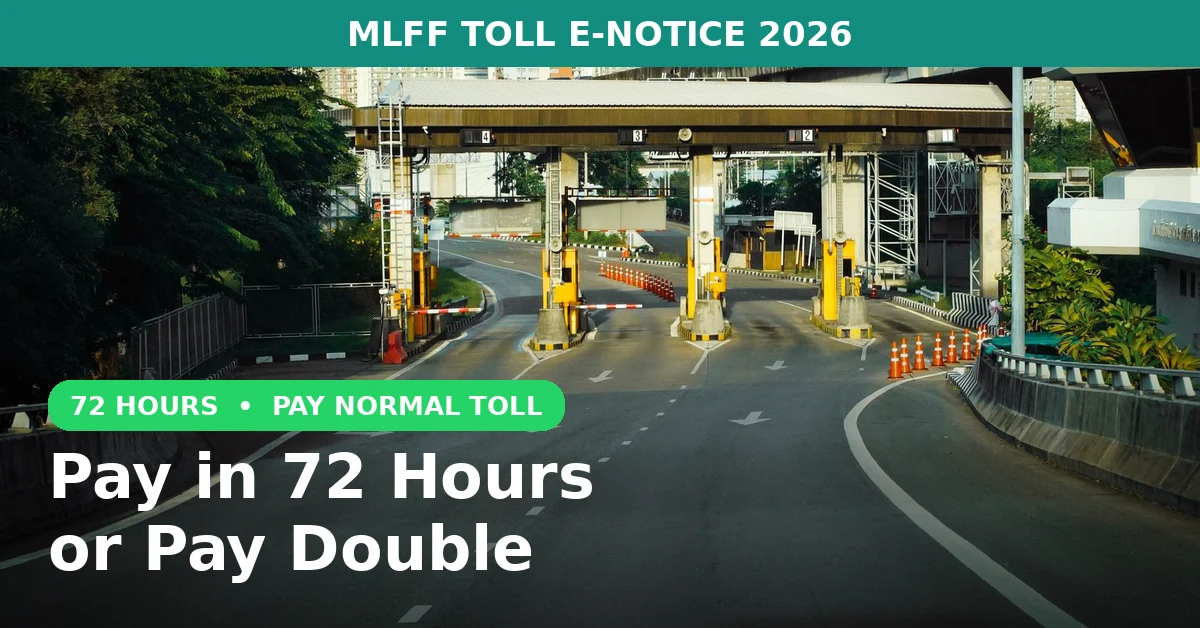
Photo: Nandhu Kumar / Pexels — toll booths on a highway; generic illustration, not Paranur or any Indian plaza.
An mlff toll e notice is the one message no highway driver wants to find on their phone — and the one that is cheapest to deal with quickly. Since NHAI began switching on barrier-free tolling, there is no booth, no barrier and nobody to wave you down. Cameras read your number plate, the system tries your FASTag, and if the payment does not go through, an electronic notice goes out in your name. At Paranur, Tamil Nadu’s first barrier-free plaza, that system generated 3.27 lakh e-challans (toll e-notices) in its first 40 days (1 October to 9 November 2026), according to DT Next — and only 68,226 of them had been settled, for ₹1.38 crore. Most of the rest are already past their 72-hour window, when the amount doubles.
This guide explains what an MLFF toll e-notice is, why you get one, the exact 72-hour rule, what happens after 72 hours and after 15 days, how to check and pay it on the official portal, and how to challenge it if the notice is wrong. It is not about the ordinary toll you pay at a staffed plaza — that is a different set of rules, covered in our double toll without FASTag guide.
Contents
- What is MLFF barrier-free tolling?
- What is an MLFF toll e-notice?
- How the MLFF toll e notice works: the 72-hour rule
- Double — or four times? Why you may read both figures
- What happens after 15 days: VAHAN
- How to check and pay an e-notice
- How to challenge an e-notice within 72 hours
- Paranur in 40 days: what the numbers say
- How to avoid the next e-notice
- FAQs
- Sources
What is MLFF barrier-free tolling?
MLFF stands for Multi-Lane Free Flow. It is NHAI’s barrier-free tolling system: instead of lanes, booths and barriers, overhead gantries with cameras and sensors read your vehicle’s number plate (ANPR — Automatic Number Plate Recognition) and match it to your FASTag, deducting the toll as you drive through at normal speed. There is nothing to stop for and nothing to hand over.
Paranur toll plaza, on the Tambaram–Tindivanam stretch near Chennai, became Tamil Nadu’s first MLFF plaza on 1 October 2026, with the barriers removed from all lanes. MLFF was already live at Chorayasi on the Surat–Bharuch section of NH-48 in Gujarat, at Mundka-Bakkarwala on the Urban Extension Road-II (UER-II) in Delhi, at Daulatpura on the Delhi–Jaipur section of NH-48, and at Gharaunda on NH-44. Nemili, on the Chennai–Bengaluru highway (NH-48), went live on 12 November 2026 as Tamil Nadu’s second barrier-free plaza — eight plazas in all so far, with more, including Chennasamudram on the Chennai–Bengaluru highway, reported to follow after trials.
The system only works smoothly when the FASTag works. The gantry has to find a valid tag with enough balance. When it cannot — and at a busy plaza that happens thousands of times a day — the toll does not simply vanish. That is where the e-notice comes in.
What is an MLFF toll e-notice?
An e-notice is the formal electronic demand NHAI issues when a vehicle crosses an MLFF toll point but the toll is not paid through FASTag. It is issued under the National Highways Fee (Second Amendment) Rules, 2026, which came into force on 17 March 2026 and amended Rule 14 of the National Highways Fee (Determination of Rates and Collection) Rules, 2008.
You get an e-notice when any of these happens at an MLFF plaza:
- your FASTag balance is too low to cover the toll;
- your FASTag is inactive, blacklisted or invalid (for example, a duplicate tag or one that was never properly affixed);
- the system cannot read or match your vehicle — no tag found, or the plate read does not match a tag;
- your vehicle has no FASTag at all.
The e-notice is sent by SMS to the mobile number registered against your vehicle in the VAHAN database, and also to the mobile number linked to your FASTag with your issuer bank. It carries your vehicle number, the date and place of the crossing, and the amount due. You can also view it on the official portal, nhfeenotice.parivahan.gov.in — the NHAI barrier-less tolling e-notice and grievance portal run by the National Informatics Centre (NIC).
One distinction that matters: an MLFF e-notice is not a traffic e-challan. A traffic e-challan is a fine for a Motor Vehicles Act offence, issued on echallan.parivahan.gov.in, with a 45-day window to pay or contest under Rule 167. An MLFF e-notice is a demand for an unpaid toll under the National Highways Fee Rules, and its clock is 72 hours, not 45 days. Do not confuse the two — and do not assume the 45-day rule gives you time. It does not, here. Our e-challan status guide covers the traffic-challan side separately.
How the MLFF toll e notice works: the 72-hour rule
The rule is simple once you see the mechanism behind it. The e-notice is issued for twice the applicable toll. But if you pay within 72 hours of the e-notice being issued, a 50% discount applies — so you pay only the normal toll. Pay after 72 hours and you pay the full e-notice amount: double the toll.
- Pay within 72 hours: only the normal toll (1×) is due. No penalty at all.
- Pay after 72 hours: double the toll (2×) is due.
- Unpaid beyond 15 days: the amount can be recorded on VAHAN — see the next-but-one section.
Take a ₹100 toll as an example. Cross an MLFF plaza with too little FASTag balance and an e-notice is issued for ₹200. Pay within 72 hours and the 50% discount brings it back to ₹100. Pay on the fourth day and you pay the full ₹200. The 72 hours run from the e-notice being issued, not from when you happen to read the SMS — so check the portal the same day any toll message arrives, and do not rely on the SMS alone. If you cross MLFF plazas regularly, it is worth checking nhfeenotice.parivahan.gov.in once a week even without an SMS, in case a message went to an old mobile number.
Two things the e-notice is not:
- It is not the 1.25× UPI rule. At staffed toll plazas, a vehicle without a valid FASTag that pays by UPI is charged 1.25 times the toll under a separate amendment (the Third Amendment Rules, G.S.R. 251(E)). That rule is about paying at a booth without FASTag. The e-notice rule is about an unpaid crossing at a barrier-free plaza. Our double toll without FASTag guide explains the 1.25× rule in full.
- It is not a fine for using the MLFF road. NHAI has been clear that the extra charge is for the delayed payment of a missed toll, not for driving on the corridor. A working FASTag with enough balance costs you exactly the normal toll, as always.
Double — or four times? Why you may read both figures
If you search for this rule online you will find two different answers, and it is worth saying plainly why. A launch-day report from Paranur quoted an NHAI official as saying vehicles with invalid FASTags or insufficient balance would be charged 200% of the toll through e-challans, and that if the e-challan was not paid within 72 hours the fee would be doubled again — 400% of the toll on the fourth day.
That does not match the rule as published. The NHAI/PIB-based explainer of the Second Amendment Rules says the e-notice is issued at twice the fee with a 50% discount inside 72 hours — which is the normal toll if you pay in time and double if you do not. The Daily Jagran’s report of the same rules (24 March 2026) and SignalPe’s reading say the same: normal fee within 72 hours, double after.
The most likely explanation is that the launch-day quote described the e-notice’s face value (200%) without mentioning the 50% early-payment discount. Whatever the explanation, the figure that matters is the one on your own e-notice: open it on nhfeenotice.parivahan.gov.in and pay the amount shown there within 72 hours. If the portal shows anything other than the normal toll inside the 72-hour window, raise a representation on the same portal before the window closes — see the challenge section below.
What happens after 15 days: VAHAN
If the e-notice is still unpaid 15 days after it was issued (or 15 days after a challenge to it is decided), the unpaid amount is recorded on the VAHAN system against your vehicle. Once it is on VAHAN, transport-related services for that vehicle can be blocked — the same kind of block that stops RC transfers, renewals and other RTO work until the dues are cleared.
At Paranur specifically, reports from the plaza say vehicles with unpaid e-notices have been stopped at the next plaza and asked to pay double the fee, and that a vehicle with no FASTag at all can be blocked on the VAHAN portal. The practical point is the same either way: the e-notice does not quietly expire. It follows the vehicle.
A FASTag is suspended once an e-challan is generated against the vehicle, and it stays suspended until all e-notices are cleared — this is stated both in the launch-day report from Paranur and in the NHAI/PIB-based explainer of the rules. That is one more reason to keep the tag funded and to clear any e-notice fast, rather than discovering at the next plaza that the tag no longer works.
How to check and pay an e-notice
There is only one official place to check and pay: the NHAI barrier-less tolling portal, nhfeenotice.parivahan.gov.in. Type the address yourself — do not open it from a link in an SMS, an email or a WhatsApp forward. Fake toll and challan messages with payment links are a common scam, and a genuine e-notice never needs you to click a link someone sent you.
- Open nhfeenotice.parivahan.gov.in in your browser.
- Search by your vehicle number (and the other details the portal asks for, such as the e-notice number from the SMS if you have it).
- Read the notice carefully — the plaza, the date and time of crossing, and the amount due. Check the issue date and time: your 72 hours run from there.
- Pay on the portal using the payment options it offers. Pay inside 72 hours and the discounted (normal toll) amount applies.
- Save the receipt. Keep the payment confirmation and the e-notice number. If the same crossing ever comes up again — a duplicate notice, for example — the receipt is your proof.
- Top up your FASTag immediately (and check the tag is active) so the next crossing does not generate another e-notice.
If the portal shows no e-notice but you received an SMS about one, treat the SMS with suspicion and check again by vehicle number. If the SMS contains a payment link, do not click it. A real e-notice will appear on the official portal under your vehicle number.
How to challenge an e-notice within 72 hours
If the e-notice is wrong — your FASTag was funded and active, the toll was already deducted, the vehicle shown is not yours, or the crossing never happened — you can raise a representation (a grievance) on the same portal, nhfeenotice.parivahan.gov.in, within 72 hours of receiving the e-notice.
- Do not pay first if you are going to challenge. Paying settles the notice; challenging is for notices you believe are wrong.
- Gather your proof before you file: a screenshot of your FASTag balance and transaction history showing the balance on the crossing date, the FASTag deduction SMS or bank statement if the toll was already deducted, your RC, and the e-notice itself.
- File the representation on the portal within 72 hours, stating clearly what is wrong and attaching the proof. Keep the acknowledgement or reference number the portal gives you.
- Watch the 15-day clock. If the challenge is not decided in your favour, the amount becomes payable, and if it stays unpaid 15 days after the notice (or after the challenge is decided), it can be recorded on VAHAN. Do not file a challenge and then forget about it — check the portal for the decision.
The tolling agency must decide your representation within five days. If it does not decide in that time, its claim to the unpaid fee expires — the grievance is treated as accepted in your favour. If the representation is rejected, you must pay the e-notice amount.
If the toll was wrongly deducted from your FASTag — a double deduction, or a deduction for a vehicle that never crossed — that is a different complaint: a FASTag wrong-deduction complaint to your issuer bank, covered in our FASTag wrong deduction guide. An e-notice challenge is for a notice you should never have received; a deduction complaint is for money that wrongly left your account.
Paranur in 40 days: what the numbers say
Paranur is the clearest picture yet of how MLFF behaves at scale — and the picture is that a lot of drivers were not ready. According to DT Next (17 November 2026), in the plaza’s first 40 days, from 1 October to 9 November 2026:
- 3.27 lakh e-challans were generated for toll violations;
- 68,226 of them had been settled;
- ₹1.38 crore had been collected;
- 15,247 complaints had been received.
That is roughly one in five notices settled in the first 40 days. A separate report from 5 November 2026 gives the background: in October alone, 19,18,967 vehicles passed through Paranur, and 3,06,307 of them had insufficient FASTag balance, closed tags or duplicate tags. The scale of the problem is not a few careless drivers — it is a large share of daily traffic crossing with a tag that cannot pay.
Two honest caveats. First, the DT Next figures are as reported by that newspaper; this guide could not independently re-open the DT Next article itself, so the figures are attributed to DT Next and should be read as reported. Second, “complaints” is a broad word — it covers everything from genuine wrong notices to drivers disputing a charge they did incur — so 15,247 complaints does not mean 15,247 wrong e-notices. What the numbers do show, without much doubt, is that keeping your FASTag funded is no longer a small courtesy at MLFF plazas. It is the difference between the normal toll and double.
How to avoid the next e-notice
- Keep a buffer in your FASTag. Top up before a highway trip, not after the low-balance SMS. A few hundred rupees of buffer covers most single tolls.
- Check the tag is active. A tag that is blacklisted, reported lost, or replaced by a duplicate will not pay. Check the status in your issuer bank’s app.
- Fix the tag to the windscreen properly. A loose, wrongly placed or damaged tag may not be read by the gantry.
- Make sure the mobile number on your RC is current. The e-notice SMS goes to the number in VAHAN. If you changed numbers and never updated the RC, the notice — and its 72-hour clock — can run without you knowing.
- Check the portal after a highway trip. If you crossed an MLFF plaza, a one-minute check on nhfeenotice.parivahan.gov.in is cheaper than a doubled toll.
- Know the toll before you travel. Our NHAI toll rates guide lists the current rates for major expressways and highways, so the amount on any e-notice can be checked against the published rate.
FAQs
What is an MLFF toll e-notice?
It is the electronic notice NHAI issues when your vehicle crosses a barrier-free (MLFF) toll plaza but the toll is not paid through FASTag — too little balance, an inactive tag, or the vehicle not being read. It is issued under the National Highways Fee (Second Amendment) Rules, 2026, and it is a demand for the unpaid toll, not a traffic fine.
How long do I have to pay an MLFF e-notice?
72 hours from the e-notice being issued. Pay inside 72 hours and only the normal toll is due. Pay after 72 hours and the amount doubles. Leave it unpaid beyond 15 days and it can be recorded on VAHAN, blocking vehicle services.
Where do I check and pay an MLFF e-notice?
On the official portal nhfeenotice.parivahan.gov.in, by vehicle number. Type the address yourself; never pay from a link in an SMS.
Is an MLFF e-notice the same as a traffic e-challan?
No. A traffic e-challan is a fine for a Motor Vehicles Act offence, with a 45-day window to pay or contest under Rule 167. An MLFF e-notice is a demand for unpaid toll under the National Highways Fee Rules, with a 72-hour window. The 45-day rule does not apply to e-notices.
Is the double charge the same as the 1.25× UPI rate?
No. The 1.25× rate applies when you pay by UPI at a staffed plaza without a valid FASTag, under a separate amendment (G.S.R. 251(E)). The e-notice double charge applies to an unpaid crossing at a barrier-free MLFF plaza. See our double toll without FASTag guide for the 1.25× rule.
Can I challenge an MLFF e-notice?
Yes — raise a representation on nhfeenotice.parivahan.gov.in within 72 hours of receiving the e-notice, with proof such as your FASTag balance and transaction history. Keep the acknowledgement number and check the portal for the decision.
Which plazas use MLFF now?
Eight so far, including Paranur (Tamil Nadu, from 1 October 2026), Nemili (Tamil Nadu, from 12 November 2026), Chorayasi (Surat–Bharuch, NH-48), Mundka-Bakkarwala (UER-II, Delhi), Daulatpura (Delhi–Jaipur, NH-48) and Gharaunda (NH-44). More plazas, including Chennasamudram on the Chennai–Bengaluru highway, are reported to follow after trials.
Sources
- DT Next, 17 November 2026 — Paranur: 3.27 lakh e-challans in the first 40 days (1 Oct–9 Nov 2026), 68,226 settled, ₹1.38 crore collected, 15,247 complaints. (Figures as reported; the DT Next article itself could not be re-opened in this session — see the note in the Paranur section.)
- Conven.org, 2 October 2026 — “Booth-less toll fee collection at Tamil Nadu’s Paranur: how does the multi-lane free flow system work?” (citing NHAI/PIB): Rule 14, e-notice at twice the user fee with a 50% discount if paid within 72 hours; e-notice by SMS to the VAHAN-registered mobile and the FASTag-linked mobile; Paranur live 30 September/1 October 2026: conven.org
- The Daily Jagran, 24 March 2026 — new toll rules: pay within 72 hours, only the standard fee; after 72 hours, double; challenge within 72 hours of receiving the e-notice; unpaid after 15 days, posted on VAHAN; rules in force from 17 March: thedailyjagran.com
- SignalPe — “How to Pay Traffic Challan Online in India (2026 Rules)”: MLFF e-notice under the Second Amendment Rules in force from 17 March 2026; pay within 72 hours, normal toll; otherwise twice the toll; unpaid beyond 15 days with no representation pending, recorded in VAHAN: signalpe.com
- Ghanamma, 2 October 2026 — Paranur goes live: 200% e-challan for invalid/insufficient FASTag, doubled again after 72 hours (400%) per an NHAI official; FASTag suspended on e-challan generation; trials at Chennasamudram and Nemili (Nemili has since gone live — see above): ghanamma.com (conflicts with the PIB-based mechanism — see the “Double — or four times?” section)
- TechWordNews, 5 November 2026 — Chennai–Tiruchi NH toll plazas: 19,18,967 vehicles passed Paranur in October; 3,06,307 had insufficient balance, closed or duplicate tags; e-challans issued; stopped at the next plaza to pay double; no FASTag, blocked on Vahan: techwordnews.com
- Trayaan — “Multi-Lane Free Flow (MLFF) Tolling: What to know, Features, and How to Check e-Notices”: e-notice mechanism, 72-hour window, portal nhfeenotice.parivahan.gov.in; Chorayasi, Mundka-Bakkarwala, Daulatpura, Gharaunda launches: trayaan.com
- PrepMatic — Paranur MLFF (PIB, MoRTH, 1 October 2026): Tamil Nadu’s first MLFF at Paranur, NH-179B Tambaram–Tindivanam; other plazas listed (Chorayasi, Mundka-Bakkarwala, Shahjahanpur, Daulatpura, Manoharpura, Gharaunda): prepmatic.in
- Live Chennai / NHAI release, 13–15 November 2026 — MLFF implemented at Nemili Toll Plaza, NH-48 (Sriperumbudur–Karaipettai section), from midnight 12 November 2026, Tamil Nadu’s second barrier-free plaza; Chennasamudram next after trials: livechennai.com
- CarKhabri — “NHAI Explains MLFF Toll System; Warns of Double Charges on Delay”: e-notice when FASTag payment is missed or not detected; settle within 72 hours at the standard rate, double after; check and pay on the NIC portal: carkhabri.com
- Official portal (NHAI/NIC): nhfeenotice.parivahan.gov.in
- Our guides: Double Toll Without FASTag 2026 (post 2216), NHAI Toll Rates 2026 (post 2261), FASTag Wrong Deduction Complaint (post 2295), How to Check E-Challan Status Online (post 27) — all verified live via the site connector, 19 November 2026
- Photo: “Toll booth on a Bangkok highway with urban skyscrapers in the background, during a clear day” by Nandhu Kumar, Pexels photo 16967276 — pexels.com
Figures in this article are dated: the MLFF rules are as in force since 17 March 2026 under the National Highways Fee (Second Amendment) Rules, 2026; the Paranur figures are as reported by DT Next on 17 November 2026 for 1 October–9 November 2026. The amount shown on your own e-notice on nhfeenotice.parivahan.gov.in is always final.
Disclaimer: this is a private information guide, not a government website. Toll rules and portal steps can change — always verify on nhfeenotice.parivahan.gov.in or parivahan.gov.in before acting. Never pay a toll or a challan from a link in an SMS; use only the official portals, and never share your OTP, UPI PIN or bank password with anyone — the government never asks for OTPs.
Related: double toll without FASTag (the 1.25× UPI rule at staffed plazas), NHAI toll rates 2026, and FASTag wrong deduction complaints.
WRITTEN BY

Manish is the content curator at OnlineChallanChecker.com, a trusted platform for checking challan status, payment updates, and traffic fine information across India. With over 5 years of experience in digital content creation and online service platforms, Admin is committed to delivering accurate, easy-to-understand guides that help users manage their challans effortlessly.