
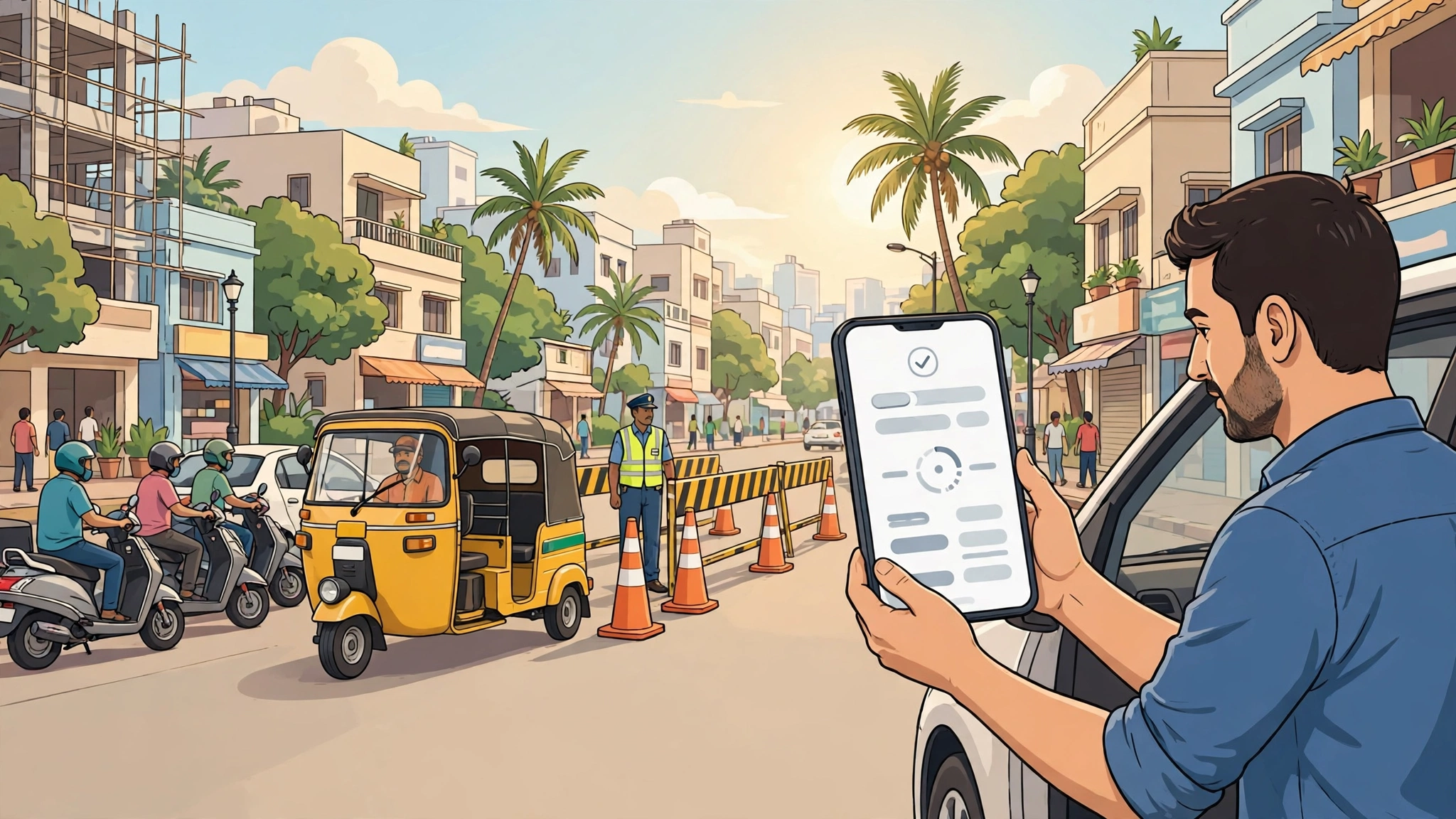
If you drive in Tamil Nadu, a Tamil Nadu e-Challan can be issued to your vehicle without you ever being handed a paper slip. Traffic cameras and enforcement officers record the violation, upload it to the national database, and the fine waits against your vehicle number or driving licence until you check and pay it. This guide explains, in plain steps, how to check your Tamil Nadu e-Challan status, how to pay safely on the official portal, and what to do if a challan against your name is wrong.
Many drivers only discover a pending challan when they sell a vehicle, renew a licence, or face a court notice. A two-minute check today can save all of that. Everything below uses the official national e-Challan system, which covers Tamil Nadu along with the rest of India, so the steps stay the same whether the violation happened in Chennai or in a smaller town.
Quick Answer: To check a Tamil Nadu e-Challan, open the official e-Challan Parivahan portal, choose Check Challan Status, and enter your vehicle number, challan number or driving licence number. Any pending challan will show the offence, the issuing authority and the amount. Pay it on the same portal using UPI, net banking or a card, and download the receipt as proof.
✓ Fine rates on this page are verified from Tamil Nadu G.O.(Ms) No. 758 (Oct 2022) · Official portal: echallan.parivahan.gov.in · Updated November 2026
Contents
- What is Tamil Nadu e-Challan?
- How to Check Tamil Nadu e-Challan Status Online
- How to Pay the Challan Online
- Check via Vahan and Parivahan Services
- How to Contest a Wrong Challan
- Common Traffic Violations in Tamil Nadu
- Traffic Challan Fine Rates in Tamil Nadu (2026 Chart)
- Settle Your Pending Challans in Lok Adalat in Tamil Nadu
- What Happens If You Don’t Pay Your Tamil Nadu e-Challan?
- Pay Your Tamil Nadu e-Challan Offline
- Details You Need
- Tamil Nadu e-Challan Notes
- e-Challan in Tamil Nadu’s Major Cities
- Frequently Asked Questions
- Check e-Challan in Other States
What is Tamil Nadu e-Challan?
An e-Challan is a digital traffic fine. Instead of a handwritten paper receipt, the violation is recorded electronically with details such as the vehicle number, the offence, the place, the date and time, and in camera cases, photographic evidence. In Tamil Nadu, challans are issued by the traffic police and transport enforcement staff, and the record is stored in the central e-Challan system run under the Ministry of Road Transport and Highways.
Chennai’s busy corridors, the highways linking Coimbatore and Madurai, and growing two-wheeler traffic in Tiruchirappalli and Salem mean camera-based enforcement is now common across the state. A signal jump recorded by a junction camera, or a helmet violation captured on a city road, can generate a challan even when no officer stops you at the spot.
Because the record is digital, it follows the vehicle and the licence holder. Unpaid challans can create problems during ownership transfer, licence renewal and other RTO work, and very old unpaid challans can be sent to court. Paying on time, or contesting a genuinely wrong challan through the proper channel, is always the cheaper and calmer option. For a general walkthrough of the national system, see our step-by-step guide to checking e-Challan status online.
How to Check Tamil Nadu e-Challan Status Online
You can search in three ways — by vehicle number, by challan number, or by driving licence number. The vehicle number search is the one most people need, because it shows every pending challan linked to that vehicle.
- Open the official e-Challan Parivahan portal for checking and paying traffic challans in your browser. Check the address bar carefully: the genuine address ends with parivahan.gov.in.
- On the home page, open the Check Online Services menu and select Check Challan Status.
- Choose your search option: Challan Number, Vehicle Number, or DL Number.
- Enter the details exactly as they appear on your registration certificate or licence, then enter the captcha shown on the screen.
- Click Get Detail. The portal lists your challans with the offence name, date, issuing authority, status and the amount payable.
- Open any challan to see the full record, including evidence images where the violation was captured by a camera.
If the result says no challan found, it means there is no record for the exact details you entered. Try once more with the vehicle number written without spaces, and if you recently bought the vehicle, also check with the previous registration details if they changed. If you received an SMS about a challan but the portal shows nothing, wait a day — uploads from local systems can take a short time to appear — and then check again.
How to Pay the Challan Online
Payment happens on the same official portal, immediately after you view the challan. Never pay through a link sent by an unknown person on a messaging app, and never pay a higher or lower amount than the portal itself shows for that challan number.
- From the challan list, select the pending challan you want to settle and click Pay Now.
- Verify the challan number, vehicle number, offence and amount on the summary screen before you proceed.
- Choose a payment method: UPI, net banking, or a debit or credit card. The portal redirects you to a secure payment gateway.
- Complete the payment and wait for the success screen. Do not refresh or press back while the payment is processing.
- Download and save the payment receipt. Keep a copy on your phone and, if possible, a printed copy with your vehicle documents.
- After some time, search for the challan again and confirm its status has changed to paid.
If money is deducted but the challan still shows as pending, do not pay a second time immediately. Payment updates can take a little while to reflect. Keep your transaction reference, wait, and check the status again later the same day or the next day. If the status still has not updated, use the grievance or helpdesk option on the official portal with your transaction details ready.
Check via Vahan and Parivahan Services
The e-Challan portal is part of the wider Parivahan family of services. Vahan handles vehicle registration data, and Sarathi handles driving licence data. When you search by vehicle number, the e-Challan system reads the same national records, which is why a challan issued anywhere in India can appear in one search.
This connection is useful in two situations. First, when you buy a used vehicle in Tamil Nadu, check its number for pending challans before you pay the seller — unpaid fines are best settled by the person who was driving when they were issued, and the check takes two minutes. Second, keep the mobile number on your registration and licence records current, because challan alerts and payment confirmations are sent by SMS. Our Online Challan Checker home page links to more state guides and related services if you drive across state borders often.
Highway drivers should also keep toll payments in order; our guide on how to recharge FASTag online explains the process step by step. And if someone in your family is just starting to drive, the complete Learning License guide for all states covers the application, fees and test in one place.
How to Contest a Wrong Challan
Mistakes do happen: a number plate misread by a camera, a challan issued after you sold the vehicle, or a violation recorded at a time your vehicle was somewhere else. Do not ignore a wrong challan, and do not pay it just to make it go away if you have clear evidence — use the dispute route instead.
- Open the challan on the official portal and note the challan number, offence, date, time and place.
- Use the grievance or dispute option available on the e-Challan portal, or contact the issuing traffic authority shown on the challan, and submit your explanation with supporting documents such as sale papers, toll receipts, parking slips or location records.
- Keep copies of everything you submit, along with any acknowledgment number you receive.
- Follow up on the same challan number until the record is corrected or a decision is communicated.
Some pending challans can also be settled through Lok Adalat sessions, where certain compounding matters are resolved in a single sitting. Read our guide on how to settle traffic challans through Lok Adalat in India to understand when that route helps and what to carry with you. If a challan has already moved to court, follow the court process shown against that challan rather than trying to pay it online, because court-referred challans are handled differently.
Common Traffic Violations in Tamil Nadu
Most challans in Tamil Nadu come from a familiar set of offences under the Motor Vehicles Act. The exact fine for each offence is shown against your challan on the official portal, and that figure — not any list on a private website, including this one — is the amount that applies to your case, because fines depend on the offence, the vehicle class and whether it is a repeat violation.
- Riding a two-wheeler without a helmet, or driving without a seat belt.
- Jumping a red light or crossing a stop line at a signal.
- Over-speeding beyond the limit set for that road.
- Using a mobile phone while driving.
- Driving without a valid driving licence, registration certificate, insurance or pollution certificate.
- Wrong-side driving, illegal parking and blocking pedestrian crossings.
- Overloading in goods vehicles and carrying passengers beyond capacity.
- Drunk driving, which carries the most serious consequences, including licence action and court proceedings.
Treat this list as a awareness checklist, not a price list. When you open your challan, the portal shows the offence section and the exact payable amount for that record.
Traffic Challan Fine Rates in Tamil Nadu (2026 Chart)
The chart below lists the compounding amounts Tamil Nadu has notified in G.O.(Ms) No. 758 (19 October 2022) for the most common traffic offences under the Motor Vehicles (Amendment) Act, 2019, so you can see at a glance what an offence can cost before you check your own challan.
| Traffic Offence | Fine (First Offence) | MV Act Section |
|---|---|---|
| Riding without a helmet | ₹1,000 + licence disqualified for 3 months | Section 194D |
| Driving without a seat belt | ₹1,000 | Section 194B |
| Over-speeding (light motor vehicle / car) | ₹1,000 | Section 183 |
| Over-speeding (medium or heavy vehicle) | ₹2,000 | Section 183 |
| Dangerous driving, red-light jumping or using a mobile phone while driving | ₹1,000 (₹10,000 for a repeat offence) | Section 184 |
| Drunk driving (first offence) | ₹10,000 and/or up to 6 months in jail | Section 185 |
| Driving without a driving licence | ₹5,000 | Section 181 |
| Driving without insurance | ₹2,000 (₹4,000 for a repeat offence) | Section 196 |
| Triple riding on a two-wheeler | ₹1,000 | Section 194C |
| Driving without a valid PUC certificate | ₹10,000 | Section 190(2) |
| Not giving way to an ambulance or fire vehicle | ₹10,000 | Section 194E |
| Other general traffic offences | ₹500 (₹1,500 for a repeat offence) | Section 177 |
Note on these amounts: These are the compounding (on-the-spot settlement) amounts from Tamil Nadu’s compounding schedule in G.O.(Ms) No. 758, Home (Transport-VII), dated 19 October 2022. A court can impose higher penalties under the Motor Vehicles (Amendment) Act, 2019, and a few offences, such as drunk driving, cannot be compounded and are decided by a court. The amount printed on your actual challan is the final amount that applies to you. You can confirm your exact challan amount on the official Parivahan e-Challan portal.
Settle Your Pending Challans in Lok Adalat in Tamil Nadu
Pending traffic challans are often settled here for less than the full fine.
A Lok Adalat is a settlement sitting organised by the Legal Services Authorities under the Legal Services Authorities Act, 1987, where pending cases are resolved by mutual agreement instead of a long court process. Traffic challans that are compoundable — especially challans that have already been transferred to a court or are pending in the virtual court — can be taken up and settled on the spot. For minor offences, the matter is often settled for less than the full fine amount. Once a challan is settled in the Lok Adalat, the case is closed and the order passed is final and binding.
This route is most useful if you have old, unpaid Tamil Nadu challans that are already pending in court. Serious or non-compoundable offences — for example, drunk driving cases that must be decided by a court — may not be taken up, and a challan that you have already paid cannot be refunded through a Lok Adalat. There is no fixed or guaranteed discount: the amount at which a challan is settled is decided by the bench at the sitting, based on the offence and the facts of the case.
Before the sitting, check your challan status on the official e-Challan Parivahan portal and note down any challans shown as transferred to court or pending in the virtual court. On the day, carry the challan details, your vehicle registration certificate (RC) and your driving licence. Confirm the exact date, venue and any token or registration requirement with your District Legal Services Authority or on the Tamil Nadu State Legal Services Authority website. Tamil Nadu has moved some of its earlier sittings this year, so a final check of the date a few days ahead is a good idea. For the full process, the documents to carry and what to expect on the day, read our step-by-step guide to settling traffic challans through Lok Adalat.
What Happens If You Don’t Pay Your Tamil Nadu e-Challan?
An unpaid e-Challan does not disappear with time. It stays recorded against your vehicle number and driving licence in the national database, and it tends to surface at the worst moment — when you sell the vehicle, renew a document, or receive a court notice. In practical terms:
- The challan can be transferred to a court or the virtual court, and you may be summoned to appear or settle it there.
- Settling late usually costs more in time and money than paying the original fine promptly.
- Vehicle services such as RC renewal, fitness certification and ownership transfer can be blocked until all pending dues are cleared.
- For repeated or serious unpaid offences, action against your driving licence is possible.
- The simple fix: pay the challan online on the official portal, or settle eligible pending challans for less at a Lok Adalat.
Pay Your Tamil Nadu e-Challan Offline
If you would rather pay in person, you can pay your Tamil Nadu e-Challan offline at the traffic police station or the RTO office connected with the challan. If the challan has already been transferred to a court, it is settled through that court instead. Carry the challan number (or a print of the challan details), your vehicle registration certificate (RC) and your driving licence, and always collect the stamped receipt as proof of payment. Offline payments can take a few days to reflect in the online record, so check your status on the portal after a few days before assuming anything is wrong.
Details You Need
Keep any one of these three details ready before you start. Each one searches the same database in a slightly different way.
| Detail | Where you find it | Where it is used |
|---|---|---|
| Vehicle number | Your number plate and registration certificate (RC) | To see all challans linked to the vehicle — the most common search |
| Challan number | The SMS alert, the printed or digital challan notice | To open and pay one specific challan directly |
| Driving licence (DL) number | Your driving licence card or Sarathi record | To see challans recorded against you as a driver, across vehicles |
You will also need a mobile phone that can receive an OTP or payment confirmation, and a UPI app, net banking login or card if you plan to pay in the same session.
Tamil Nadu e-Challan Notes
Tamil Nadu e-Challan services are administered in the state through the Transport Department, Government of Tamil Nadu, working with the traffic police in each district. The capital, Chennai, and major cities including Coimbatore, Madurai, Tiruchirappalli, Salem and Vellore all report into the same national e-Challan database, so there is no separate state website you must use for a standard challan check — the national portal is the route for all of them.
Keep your mobile number updated against your vehicle registration and driving licence. Most Tamil Nadu e-Challan alerts reach owners by SMS, and an old number is the most common reason drivers discover a pending challan only when they apply for a fitness certificate, transfer ownership, or renew a document at the RTO.
One more habit worth building: after any long trip, festival travel or highway drive, do a quick vehicle-number check a week later. Camera-based challans are uploaded after the event, and catching them early keeps the payment simple and avoids escalation to court.
Tamil Nadu e-Challans are issued by two sets of officers: traffic police personnel and the transport department’s enforcement staff (MVD/RTO officers). Either can issue a challan during a roadside check, and the offences they record are entered into the same national e-Challan system.
Many challans are now created without any officer stopping you. CCTV and ANPR (automatic number plate recognition) cameras at junctions, and speed cameras on highways, record the offence together with photographic evidence, and the challan is generated against the vehicle registration number. That is why owners often first learn of a challan from an SMS or when they check their status online.
Commercial and transport vehicle owners face stricter checking. Permits, the vehicle fitness certificate and loading limits are verified regularly for transport vehicles, and overloading is treated seriously. Keep the permit, fitness certificate, insurance and pollution certificate current to avoid avoidable challans.
e-Challan in Tamil Nadu’s Major Cities
E-Challans are issued in every district of Tamil Nadu, but most people searching for their challan status come from its biggest cities, where traffic is heaviest and enforcement cameras cover the main roads and junctions. The cities that generate the most e-Challan searches in Tamil Nadu are:
- Chennai
- Coimbatore
- Madurai
- Tiruchirappalli
- Salem
Wherever in Tamil Nadu your challan was issued, the process is the same: the Parivahan check-and-pay steps explained in this guide work for challans from every city listed above, and there is no separate website or procedure for each city.
Camera-based challans recorded by CCTV and ANPR cameras are most common in the capital and the largest cities, so drivers there can receive an e-Challan without ever being stopped on the road. If you drive regularly in these cities, a quick challan status check every few weeks is a good habit.
Frequently Asked Questions
How can I check my Tamil Nadu e-Challan with just the vehicle number?
Open the official e-Challan Parivahan portal, choose Check Challan Status, select the Vehicle Number option, enter your registration number and the captcha, and click Get Detail. All pending and paid challans for that vehicle will be listed.
Is there a separate Tamil Nadu website for paying challans?
For standard traffic challans, the national e-Challan Parivahan portal is the official route and covers Tamil Nadu. Always confirm the address ends with parivahan.gov.in before entering details or paying.
What happens if I do not pay a Tamil Nadu e-Challan?
An unpaid challan stays on record against your vehicle or licence. It can block RTO services such as ownership transfer, and older unpaid challans may be sent to court, which means more time and cost to settle. Checking regularly and paying on time avoids both problems.
I paid my challan but it still shows as pending. What should I do?
Wait and check again later, because payment status can take some time to update. Keep your transaction reference and receipt safe. If the status does not change, raise it through the grievance or helpdesk option on the official portal with your payment details — do not pay the same challan twice.
Can I check a challan issued in another state on the same portal?
Yes. The e-Challan database is national, so a vehicle-number search shows challans issued in other states as well, and most of them can be paid from the same place.
How do I dispute a Tamil Nadu e-Challan that was issued by mistake?
Note the challan number, use the dispute or grievance option on the official portal or contact the issuing authority shown on the challan, and submit documents that support your case. Keep copies and follow up until the record is corrected.
Can I settle my Tamil Nadu e-Challan in a Lok Adalat?
Yes, if the challan is for a compoundable offence and is pending in court or in the virtual court. The next National Lok Adalat is scheduled for Saturday, 12 December 2026, and pending traffic challans are commonly taken up there and often settled for less than the full fine. Serious, non-compoundable offences may not be covered, so check your challan status on the official portal and confirm the date and venue with your District Legal Services Authority before you go.
How long does an e-Challan take to appear online?
Most e-Challans appear on the portal within a few hours to a few days after the offence is recorded. Camera-based challans can take longer, because the recording is reviewed and uploaded by the issuing authority, so if you were expecting one, check again after a few days.
Can I sell or transfer my vehicle with pending challans?
Usually not. An ownership transfer at the RTO is normally blocked until all pending challans against the vehicle are paid or settled. Clear the dues first, keep the payment receipts, and then go ahead with the transfer.
Check e-Challan in Other States
Received a challan outside Tamil Nadu, or checking a vehicle registered in another state? Pick the matching state guide below — the checking steps are the same everywhere, but fine rates and local notes differ from state to state.
- West Bengal e-Challan
- Odisha e-Challan
- Jharkhand e-Challan
- Assam e-Challan
- Goa e-Challan
- Uttarakhand e-Challan
- Himachal Pradesh e-Challan
- Madhya Pradesh e-Challan
- Kerala e-Challan
- Karnataka e-Challan
Conclusion
Checking and paying a Tamil Nadu e-Challan takes only a few minutes when you use the official portal and keep your vehicle number handy. Make the check a monthly habit, pay only on the genuine government website, save every receipt, and dispute a wrong challan promptly with documents instead of ignoring it. Safe driving, of course, is the simplest way to keep the list empty.
Last updated: November 2026
Disclaimer: OnlineChallanChecker.com is a private guide website and is not an official government website. We explain the process in simple language, but all challan checks and payments must be done only on official government portals such as the e-Challan Parivahan portal. Fine amounts, rules and procedures can change; the details shown on the official portal for your challan are final.

Manish is the content curator at OnlineChallanChecker.com, a trusted platform for checking challan status, payment updates, and traffic fine information across India. With over 5 years of experience in digital content creation and online service platforms, Admin is committed to delivering accurate, easy-to-understand guides that help users manage their challans effortlessly.
Pingback: Bihar E-Challan Check Online 2026 – Pay Traffic Challan & View Fine Rates
Pingback: HP e-Challan: Check Himachal Pradesh Traffic Challan Online & Pay (2026)