
Quick Answer: For a Rythu Bharosa Telangana status check, there is no public status page on the official portal — its login is for department staff only. Check your bank SMS or passbook for the Rs 6,000-per-acre credit, search PFMS “Know Your Payment” on pfms.nic.in with your bank account number, or ask your Agriculture Extension Officer. And the important news first: as of 23 November 2026, the government has not announced a date for the Rabi (Yasangi) 2026-27 instalment — any website giving you a date for it is guessing.
Last verified: 23 November 2026, against the official Rythu Bharosa portal, PFMS, and the sources listed below. Payment dates change — always confirm against the portal or your Mandal Agriculture Officer before acting.
A Rythu Bharosa Telangana status check is the search thousands of Telangana farmers run every season, and it is also the search most likely to land them on a wrong answer. The scheme pays Rs 12,000 per acre a year in two seasonal instalments, and between instalments there is a long quiet stretch in which rival websites fill the gap with expected dates that were never announced. Right now that is exactly what is happening with the Rabi instalment for 2026-27 — several popular pages still say “expected August–September 2026”, a date that has already passed with no payment. This guide gives you the honest picture: what the scheme pays, what has actually been released and when, how to check whether your money has come, who is eligible, and which lookalike scheme in the neighbouring state is not this one.
Contents
- What is Rythu Bharosa?
- How much money do you get, and when?
- Rabi (Yasangi) 2026-27: has the money been released?
- Rythu Bharosa Telangana status check: what actually works
- Who is eligible for Rythu Bharosa?
- Indiramma Atmiya Bharosa: the separate scheme for landless workers
- Not the same as Annadata Sukhibhava (Andhra Pradesh)
- Why your payment may not have come
- Frequently asked questions
- Sources
What is Rythu Bharosa?
Rythu Bharosa is the Telangana government’s crop investment support scheme for farmers who own land. It pays a fixed amount for every acre of cultivable land recorded in the farmer’s name, twice a year — once at the start of each crop season — straight into the farmer’s Aadhaar-linked bank account through Direct Benefit Transfer (DBT). The idea is working capital before the season: money for seed, fertiliser and field work, arriving when the farmer actually needs it, without a middleman.
The scheme is not new, but the name is. It was earlier called Rythu Bandhu, launched in 2018 at Rs 4,000 a season (Rs 8,000 a year), raised to Rs 5,000 a season (Rs 10,000 a year) from 2019-20. In January 2025 the present state government renamed and restructured it as Rythu Bharosa and raised the support to Rs 12,000 per acre a year, under government order G.O.Rt.No.18 of 10 January 2025, effective 26 January 2025. If you were a Rythu Bandhu beneficiary, you did not need to join a new scheme — the same pattadars (landholders) are paid from the same land records, now held on the Bhu Bharati portal that replaced Dharani in April 2025.
The official portal is rythubharosa.telangana.gov.in, run by the state’s Department of Agriculture. One thing to know about it before you go there: as this article was written, the portal’s home page shows only a login box for department staff — User Name, Password and Captcha — and no public page where a farmer can type in an Aadhaar number and see a payment status. Several rival guides describe such a page in detail. It does not exist, at least not on the live portal. The status-check methods that actually work are given below.
How much money do you get, and when?
Every eligible farmer gets Rs 12,000 per acre per year, paid as Rs 6,000 per acre per season: Vanakalam (Kharif, the monsoon season) and Yasangi (Rabi, the winter season). So a farmer with 2 acres gets Rs 12,000 per season and Rs 24,000 a year; a farmer with half an acre gets Rs 3,000 per season. The money is released in phases, not to everyone on one day — smaller holdings are usually paid first, and a full round can take days or weeks to reach every beneficiary.
What has actually been paid so far at the new rate:
| Round | When | What the government reported |
|---|---|---|
| Yasangi (Rabi) 2025-26 | From 22 March 2026, launched at Narmetta village, Siddipet district | First tranche Rs 3,590 crore to nearly 70 lakh farmers; Rs 9,000 crore promised within 45 days, Rs 5,700 crore reported paid by 20 April 2026 |
| Vanakalam (Kharif) 2026-27 | From 30 June 2026, launched at Shilpakala Vedika, Hyderabad | Rs 9,000 crore to 73.30 lakh farmers within nine days, closing on 10 July 2026 |
| Yasangi (Rabi) 2026-27 | Not yet announced | No release date announced as of 23 November 2026 — see the next section |
Two notes on this table. First, the March 2026 release is often labelled “Kharif 2026” on rival sites. It was not Kharif — March falls in the Yasangi (Rabi) season, and it was the Rabi 2025-26 instalment. Second, the government releases do not state a completion date for the last part of the March round (about Rs 3,300 crore was still due after 20 April 2026), so we cannot confirm here that every farmer in that round was paid. If your March 2026 credit never arrived, check with your Agriculture Extension Officer rather than assuming it will come with the next round.
The 2026-27 state budget keeps the scheme at Rs 6,000 per acre per season and provides Rs 18,000 crore for Rythu Bharosa in the year. That is the budget provision, not money already in farmers’ accounts — the two are often confused on scheme websites.
Rabi (Yasangi) 2026-27: has the money been released?
No — not as of 23 November 2026. The Telangana government has not announced when the Rs 6,000-per-acre Yasangi instalment for 2026-27 will be paid. No announcement was made at the Chief Minister’s farmers’ meeting on 9 November, and the announcement — which usually comes before the end of December — has not yet been made. Reports in early November 2026 said the announcement was being held back while the government worked out how it would fund farmer support this Rabi season, after asking farmers to be cautious about Rabi cultivation because of water and power shortages. That is a reported reason, not an official one — the government itself has not given a date or a reason for the delay.
What this means in practice: do not trust a date you see on another website. “Expected August–September 2026” appears on several popular pages. August and September have passed, no money was released then, and those pages have not been updated. Any date for the Yasangi 2026-27 instalment that is not in a government press release is a guess. December 2026 or January 2027 are talked about as possible timings, but they are possibilities discussed in news coverage, not announcements. Wait for an official announcement from the Agriculture Department or the Chief Minister’s office.
Rythu Bharosa Telangana status check: what actually works
There is no single “check status” button for this scheme, so use the methods below in order. They are the methods the government itself points farmers to — the bank, the central payment tracker, and the local agriculture officer.
Method 1 — Check your bank account. This is the first and most reliable check, because the money arrives by DBT. Look for the credit in your bank SMS alerts, your passbook, or your account statement. The credit will be Rs 6,000 per acre of your recorded holding — Rs 6,000 for one acre, Rs 12,000 for two, and so on. If the amount is different from what you expect, check your recorded land extent on Bhu Bharati first — the payment follows the land record, not what you remember owning.
Method 2 — PFMS “Know Your Payment”. PFMS is the central government’s Public Financial Management System, and it has a free public facility that shows payments made to a bank account through the system. You do not need a login. Open pfms.nic.in (check the address ends in .nic.in), find “Know Your Payment” on the home page, select your bank, enter your bank account number (you may be asked to type it twice), fill in the captcha, and click Search. Payments made to that account through PFMS appear with their status. One honest limit: not every government payment appears in the same place on PFMS, so a blank result there does not by itself prove no payment was made. Use it together with the bank check, not instead of it. Never type your Aadhaar or bank details into any third-party website or app that claims to check Rythu Bharosa status for you.
Method 3 — Ask your Agriculture Extension Officer (AEO) or Mandal Agriculture Officer (MAO). The Rythu Bharosa portal’s Contact Us page lists mobile numbers for District Agriculture Officers, Assistant Directors of Agriculture, MAOs and AEOs. Your AEO can check whether your name is on the beneficiary list for the current round and whether a payment against your name failed. Take your pattadar passbook and Aadhaar when you go. The Rythu Vedika in your area and the Mandal Agriculture Office are the right places for this; a MeeSeva centre can help with land-record printouts but cannot check your payment.
Method 4 — Check your land record on Bhu Bharati. Most “missing payment” problems start here, not at the bank. Open bhubharati.telangana.gov.in — the state’s land records portal, which replaced Dharani on 14 April 2025 — and check that the land shows in your name with the correct extent, searching by survey number or pattadar passbook number. If the name or extent is wrong, the payment will be wrong too, and it has to be corrected through the revenue records first.
Who is eligible for Rythu Bharosa?
- You must own cultivable agricultural land in Telangana recorded in your name in the Bhu Bharati land records. The beneficiary list is drawn from the land records — that is why there is no fresh application form every season for existing pattadars.
- The amount follows the land in the record. If you bought land, inherited it, or had a mutation recorded, the payment follows the updated record. If the record still shows the previous owner, the money goes to the previous owner’s account — get the mutation done first.
- There is no separate application for each season. New pattadars, or farmers whose records need correction, should meet the Agriculture Extension Officer at the Rythu Vedika or the Mandal Agriculture Office with the passbook, Aadhaar and bank details.
- Tenant farmers are not covered as pattadars under Rythu Bharosa, because the scheme pays the recorded landowner. If you farm land you do not own, read the next section about the separate scheme for landless workers — and ask your MAO which scheme, if any, covers your situation, because guides disagree on whether tenant farmers fall under it.
Your bank account must be linked with Aadhaar (Aadhaar seeding) for the DBT to reach you. This is the single most common reason a payment fails: the money is released against your name, the bank cannot match the Aadhaar seeding, and the credit bounces. If a round has been paid to other farmers in your village and not to you, check the Aadhaar seeding at your bank branch first.
Indiramma Atmiya Bharosa: the separate scheme for landless workers
Rythu Bharosa is for landowners. The state runs a separate scheme, Indiramma Atmiya Bharosa, for landless agricultural labourer families — launched on the same day, 26 January 2025. It pays Rs 12,000 per family per year, in two instalments of Rs 6,000, by DBT to the Aadhaar-linked bank account. The 2026-27 budget provides Rs 600 crore for it, and around 5.8 lakh families are expected to benefit.
Beneficiaries are picked from the MGNREGS database: the family must hold a job card and at least one member must have worked 20 or more days under MGNREGS in 2023-24, and only one member per family is covered. The draft list is checked at the village level (gram sabha) before it is finalised. If you are a landless farm worker, this is the scheme to ask about at your gram panchayat or MPDO office — not Rythu Bharosa, and not the Rabi instalment dates in this article.
Not the same as Annadata Sukhibhava (Andhra Pradesh)
This confusion causes more wrong expectations than anything else in this topic, so it is worth one short paragraph. Annadata Sukhibhava is an Andhra Pradesh scheme, not a Telangana one. It pays Andhra Pradesh farmer families Rs 20,000 a year in total — Rs 14,000 from the state government plus Rs 6,000 from the central PM-KISAN scheme — in three instalments. Its second instalment of 2026-27, Rs 7,000 per family (Rs 5,000 from the state plus Rs 2,000 from PM-KISAN), was credited on 30 October 2026 — Rs 3,125.47 crore in total to 46.85 lakh families, with 17,828 accounts still pending for technical reasons. Its portal is annadathasukhibhava.ap.gov.in.
None of those figures apply in Telangana. Rythu Bharosa pays Rs 12,000 per acre per year — per acre, not per family — and Telangana has no Rs 20,000 or Rs 15,000 version of it. Several web pages mix the two states’ schemes together and quote Rs 15,000 or Rs 20,000 for Rythu Bharosa. Those figures are wrong for Telangana. If you live in Telangana, ignore any “Rythu Bharosa” figure above Rs 12,000 per acre.
Why your payment may not have come
- Aadhaar not seeded to your bank account. The DBT cannot be credited. Visit your bank branch with your Aadhaar and passbook and get the seeding done, then tell your AEO so the next round picks it up.
- Land record mismatch. The name, survey number or extent in Bhu Bharati does not match your passbook. Correct it through the revenue records — the payment follows the record.
- Bank account problems. A dormant or frozen account, or an account number changed without updating the scheme record, will bounce a payment. Check the account is active and the number on record is current.
- You were paid in a later phase. Rounds are released in phases over days or weeks, smaller holdings first. If your neighbours have been paid and you have not, wait a few days and check again — then ask the AEO if it still has not come.
- The round has not been announced yet. For the Yasangi 2026-27 instalment this is currently the answer: no money has been released at all, so there is nothing to check yet.
Do not pay anyone who offers to “release” your payment or add your name to a list. There is no fee for Rythu Bharosa, no agent can speed up a round, and anyone asking for money or your Aadhaar OTP in connection with the scheme is running a scam. In November 2026, fake SMS messages claiming Rythu Bharosa money had been deposited were sent to around 2.73 lakh farmers across Telangana. Farmers went to their banks and found nothing had been credited. The Agriculture Department clarified that no funds had been released and lodged a complaint with the Cyber Crime police. A message is not a payment — the only proof is your bank passbook or statement, or the PFMS record.
If your crop itself was damaged, check your crop-insurance claim separately — see our PM Fasal Bima claim status check.
Frequently asked questions
How do I check my Rythu Bharosa Telangana status?
There is no public status page on rythubharosa.telangana.gov.in — its login is for department staff. Check your bank SMS or passbook for the Rs 6,000-per-acre credit, search PFMS “Know Your Payment” on pfms.nic.in with your bank account number, or ask your Agriculture Extension Officer with your pattadar passbook and Aadhaar.
How much money do I get under Rythu Bharosa?
Rs 12,000 per acre per year, paid as Rs 6,000 per acre in each of the two seasons — Vanakalam (Kharif) and Yasangi (Rabi) — by DBT to your Aadhaar-linked bank account.
When will the Rabi (Yasangi) 2026-27 instalment come?
No date has been officially announced as of 23 November 2026. The “August–September 2026” date on many websites is out of date and wrong. December 2026 or January 2027 are discussed as possibilities, but they are not announcements — wait for the government’s own announcement.
Is Rythu Bharosa the same as Rythu Bandhu?
Rythu Bharosa replaced Rythu Bandhu in January 2025 (G.O.Rt.No.18 of 10 January 2025, effective 26 January 2025). Rythu Bandhu paid Rs 10,000 per acre a year; Rythu Bharosa pays Rs 12,000. It is the same idea under a new name with a higher amount — not a scheme you need to join separately.
Do I need to apply every season?
No. Existing pattadars are paid from the land records, so there is no fresh application each season. New pattadars and corrections go through the AEO at the Rythu Vedika or Mandal Agriculture Office.
Can tenant farmers get Rythu Bharosa?
Not as pattadars — the scheme pays the recorded landowner. Landless agricultural labour families are covered separately under Indiramma Atmiya Bharosa (Rs 12,000 per family a year). Whether tenant farmers fall under that scheme is not settled in the guides we checked — ask your Mandal Agriculture Officer.
Is Rythu Bharosa Rs 20,000 a year?
No. That is Andhra Pradesh’s Annadata Sukhibhava scheme (Rs 14,000 state + Rs 6,000 PM-KISAN). In Telangana, Rythu Bharosa is Rs 12,000 per acre per year. Do not mix the two states’ figures.
My neighbour was paid and I was not. What do I do?
First check your Aadhaar seeding at the bank and your land record on Bhu Bharati — those two cause most failures. Then check PFMS “Know Your Payment”. If the round is still being paid in phases, wait a few days. If it still has not come, take your passbook and Aadhaar to your AEO or Mandal Agriculture Office.
Sources
- Rythu Bharosa portal, Government of Telangana (rythubharosa.telangana.gov.in) — home page shows a staff-only Login box (User Name, Password, Captcha); no public farmer status search. Opened live 23 November 2026 (cached copy 7 July 2026). rythubharosa.telangana.gov.in
- Telangana Budget in Brief 2026-27 / Budget Speech 2026-27 (20 March 2026) — Rythu Bharosa kept at Rs 6,000 per acre per season, provision Rs 18,000 crore; Indiramma Atmiya Bharosa Rs 600 crore. Cited via IndiaDigital’s scheme pages, checked 1 November 2026. indiadigital.org — Rythu Bharosa (TG)
- G.O.Rt.No.18 of 10 January 2025 — Rythu Bandhu replaced by Rythu Bharosa at Rs 12,000 per acre a year, effective 26 January 2025. Cited via Schemkosh, fact-checked 25 October 2026. schemekosh.com — Rythu Bandhu / Rythu Bharosa
- Government releases on the March 2026 (Yasangi 2025-26) and June–July 2026 (Vanakalam 2026-27) rounds — Rs 3,590 crore first tranche on 22 March 2026 at Narmetta; Rs 9,000 crore to 73.30 lakh farmers in nine days from 30 June 2026, closing 10 July 2026. Summarised via Anantam IAS and RythuBharosa.co.in, checked November 2026. anantamias.com — Rythu Bharosa rythubharosa.co.in — Rythu Bharosa scheme
- Kramavriddhi, 22 November 2026 — “Rythu Bharosa Yasangi 2026-27: no release date yet”; no announcement at the Chief Minister’s farmers’ meeting on 9 November. kramavriddhi.com
- V6 News, November 2026 — fake Rythu Bharosa credit SMS sent to ~2.73 lakh farmers; no funds released; Agriculture Department filed a Cyber Crime complaint. youtube.com — V6 News report Also: The Hindu BusinessLine, 4 Nov 2026 — fake SMS to 2.73 lakh farmers
- PFMS, Public Financial Management System (pfms.nic.in) — “Know Your Payment” public facility: bank name + account number + captcha, no login. pfms.nic.in
- Bhu Bharati portal, Government of Telangana (bhubharati.telangana.gov.in) — Telangana’s land records system, launched 14 April 2025, replacing Dharani. bhubharati.telangana.gov.in
- Indiramma Atmiya Bharosa — Rs 12,000 per family a year for landless agricultural labour families; MGNREGS job card with 20+ days’ work in 2023-24; ~5.8 lakh families; launched 26 January 2025. Via Sarkari Yojana and IMPRO India, August–November 2026. sarkariyojana.com — Indiramma Atmiya Bharosa
- Annadata Sukhibhava, Government of Andhra Pradesh (annadathasukhibhava.ap.gov.in) — Rs 20,000 a year (Rs 14,000 state + Rs 6,000 PM-KISAN); 2nd instalment Rs 7,000 credited 30 October 2026 to 46.85 lakh families. Via Jagran Josh and Sarkari Yojana, 2026. jagranjosh.com — PM Kisan Annadata Sukhibhava 2026
- Rival pages consulted for the competition picture only (figures NOT copied): sarkariyojana.com (holds the top results; its “Rabi expected Aug–Sep 2026” is stale) and deenbandhuschool.in (conflates Telangana’s Rythu Bharosa with Andhra Pradesh’s scheme and invents an Aadhaar-login status page — both wrong).
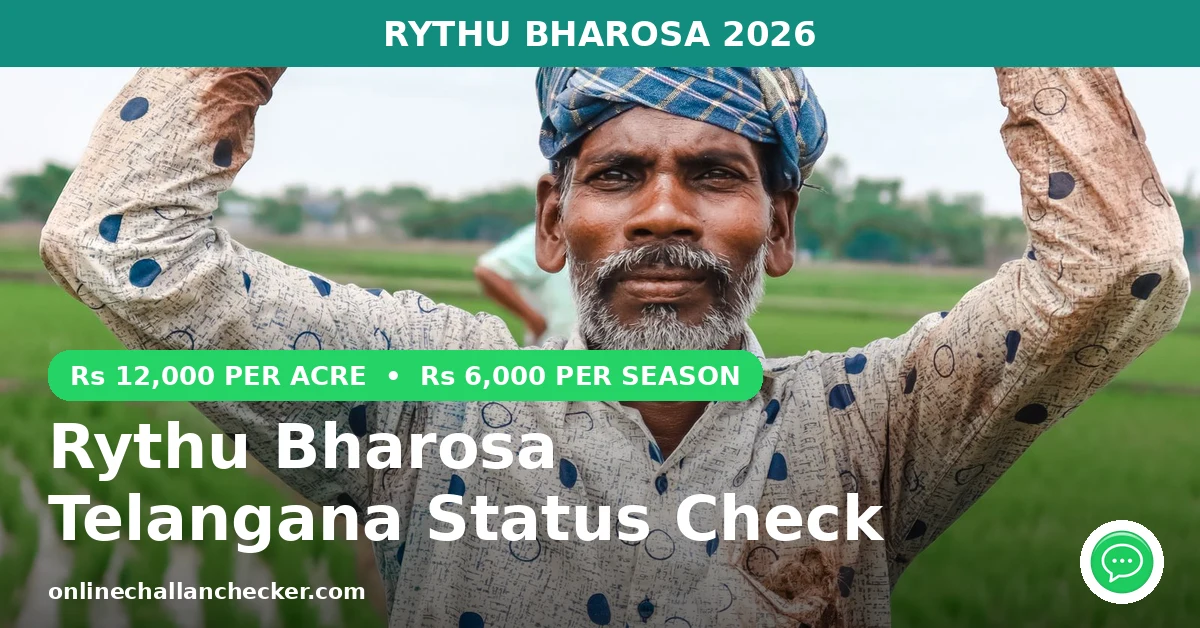
- Photo: “An old farmer with a beard holding a bucket, standing in a lush green paddy field” by Gowtham AGM, Pexels photo 18620451, free licence, 4000×6000, 4 October 2023. Generic stock illustration only. pexels.com — photo 18620451
Last verified: 23 November 2026.
WRITTEN BY
Manish is the content curator at OnlineChallanChecker.com, a trusted platform for checking challan status, payment updates, and traffic fine information across India. With over 5 years of experience in digital content creation and online service platforms, Admin is committed to delivering accurate, easy-to-understand guides that help users manage their challans effortlessly.
Pingback: Annadata Sukhibhava Status Check 2026: ₹20,000, 2nd Installment Date