
Quick Answer: To do Ujjwala Yojana apply online, go to the official portal pmuy.gov.in and use the online application option, or apply in person at any LPG distributor of your choice with your KYC form, Aadhaar, ration card and bank details. An adult woman (18+) from a poor household with no other LPG connection in the house can apply. The connection is deposit-free, the first refill and stove are free, and a Rs 300 subsidy per 14.2 kg cylinder is credited to the bank account by DBT on the first 4 refills a year — confirmed by a Ministry of Petroleum and Natural Gas release of 7 June 2026 and a Lok Sabha reply of 23 July 2026 — so the most you can get in a year is Rs 1,200. Applying is free; never pay an agent.
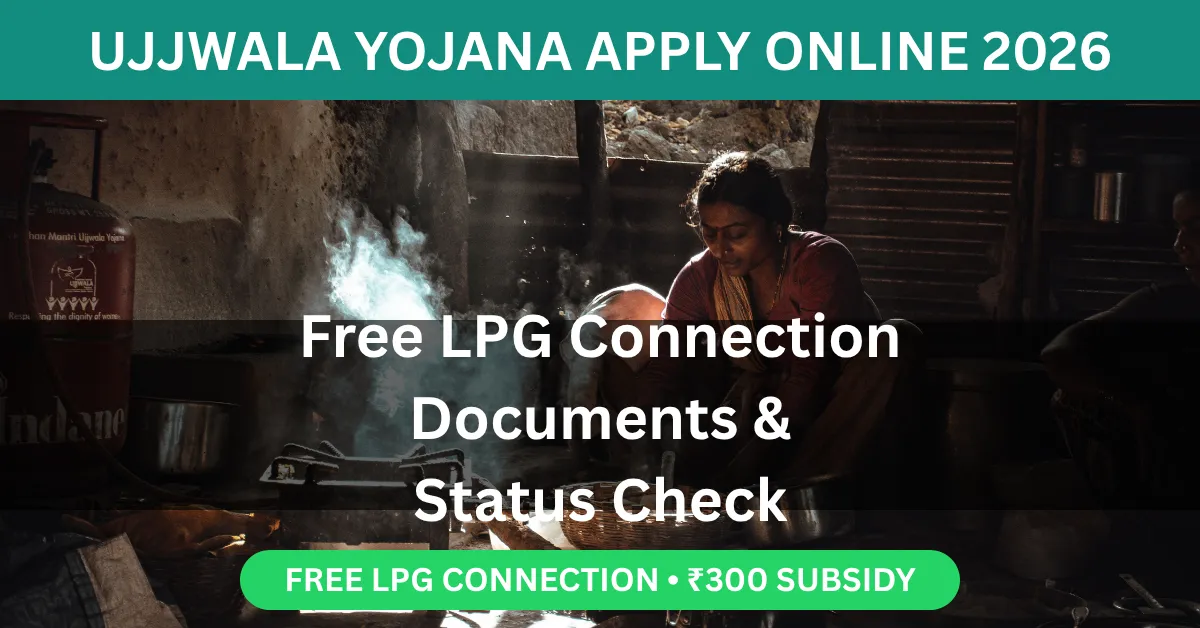
Photo by throughmylife_in_ INDIA on Pexels.
Ujjwala Yojana apply online is the way most women first look for this scheme — and the honest answer starts with a warning, not a form link. The Pradhan Mantri Ujjwala Yojana (PMUY) gives a deposit-free LPG connection in the name of an adult woman from a poor household, so her family can stop cooking on firewood and dung. More than 10.58 crore connections have been released under the scheme, the government told the Lok Sabha on 23 July 2026 — and the scheme’s own portal shows 10,56,85,306 connections as on 23 September 2026. But right now new domestic LPG connections are widely reported to be on hold, with no restart date announced, so an application today may mean joining a waiting list rather than getting a cylinder this week. This guide gives you the real apply steps from the official portal, the documents you need, the subsidy as it stands, and the one thing that is genuinely unsettled — the new-connections pause — stated plainly instead of papered over.
Contents
- What is Ujjwala Yojana 2.0?
- How to do Ujjwala Yojana apply online: step by step
- Who can apply — eligibility
- Documents needed
- What you get — the Rs 300 subsidy
- How many subsidised refills a year: 4
- e-KYC: the biometric check you must do
- How to check your application and subsidy status
- New connections on hold — what it means for you
- Uttar Pradesh only: 2 free refills in 2026-27
- FAQs
- Sources
What is Ujjwala Yojana 2.0?
Pradhan Mantri Ujjwala Yojana was launched on 1 May 2016 at Ballia, Uttar Pradesh, to give deposit-free LPG connections to adult women from poor households. The second phase, Ujjwala 2.0, was launched on 10 August 2021 from Mahoba, Uttar Pradesh. Under Ujjwala 2.0, an eligible woman gets a deposit-free LPG connection along with the first refill and a hotplate (stove) free of cost. The connection is issued in the woman’s name, and the Rs 300 targeted subsidy on refills is paid by Direct Benefit Transfer (DBT) into her Aadhaar-linked bank account.
The scale is enormous. The government told the Lok Sabha on 23 July 2026 that oil marketing companies had released 10.58 crore PMUY connections as on 1 July 2026, including 25 lakh connections under the latest extension approved for 2025-26. The scheme’s own portal, pmuy.gov.in, shows 10,56,85,306 connections released as on 23 September 2026, of which 24,42,525 were under that latest 25-lakh extension. Uttar Pradesh has the most connections (about 1.90 crore), followed by West Bengal and Bihar. The average Ujjwala household used 4.71 cylinders in 2025-26, according to the same Lok Sabha reply — a number that matters when you read the section below about how many refills the subsidy covers.
One clarification about the name: you will see “Ujjwala Yojana 2.0” and “Ujjwala Yojana 3.0” used online. Ujjwala 2.0 is the current phase on the official portal. No official PMUY page or PIB release confirming a “3.0” phase was located during research for this article, so this guide does not treat 3.0 as a separate scheme.
How to do Ujjwala Yojana apply online: step by step
The official portal says, in its own words, that “applicants may apply to any distributor of her choice either by submitting application at the distributor or by submitting a request through Online Portal.” There are three routes, and you should use whichever one actually works for you — but read the warning at the end of this section first.
- Online — through the official portal: open pmuy.gov.in and look for the new-connection / apply option (the official Ujjwala 2.0 page is pmuy.gov.in/ujjwala2.html). Fill in the KYC application form with the applicant’s details, upload or keep ready the documents listed below, and submit. Keep the acknowledgement or application number you get — you will need it to follow up.
- In person — at an LPG distributor: go to any LPG distributor of your choice (Indane, Bharat Gas or HP Gas) with the filled KYC application form and your documents. The distributor verifies the documents and processes the application. This is the route most applicants actually use, and it is the one to fall back on if the portal does not work for you.
- Through a Common Service Centre (CSC): the portal also lists CSCs as a booking and service point. A CSC can help you fill and submit the form — but it should charge only the standard CSC service fee, if any, and never a large “scheme fee”. If anyone demands money to “get your connection approved”, walk away.
Important — check before you travel: several reports say the online application link on the official website is currently not working, and that new domestic LPG connections have been paused since spring 2026 (see the “New connections on hold” section below). The official Ujjwala 2.0 page still lists the online portal as an option, so try it first — but if the link does not work, go to your nearest distributor instead and ask whether new applications are being accepted or waitlisted in your area. Do not pay anyone who promises to “activate” the online link or jump the queue.
Who can apply — eligibility
The eligibility conditions below are taken from the official PMUY page (pmuy.gov.in/ujjwala2.html), checked live on 17 November 2026:
- An adult woman: the applicant must be a woman who has attained 18 years of age. The connection is issued in her name.
- No other LPG connection in the household: there should be no other LPG connection from any oil marketing company within the same household.
- From a poor household: the adult woman must belong to a poor household, shown by submitting a deprivation declaration in the prescribed format. The government has simplified the test to this declaration — the official page no longer asks you to fit one of the old category lists first.
There is no application fee for the scheme itself. If you already have an LPG connection in the house in someone else’s name, you are not eligible for a second one under PMUY. If you are unsure whether your household qualifies as a “poor household” for this purpose, the distributor will check your ration card and the deprivation declaration when you apply — do not let an agent charge you for this check.
Documents needed
Keep these ready before you apply, exactly as the official PMUY page lists them:
- KYC application form — filled in and signed.
- Proof of identity: Aadhaar copy of the applicant.
- Proof of address: only needed if the address on your Aadhaar is different from where you currently live. Migrant applicants can give a self-declaration as per Annexure I.
- Ration card issued by the state you are applying from, or another state government document certifying your family composition. Migrant applicants can use the Annexure I self-declaration instead.
- Aadhaar copies of the applicant and the adult family members named in the ration card or family-composition document.
- Bank account details: passbook copy or a cancelled cheque, for the account the subsidy will be credited to. The account must be Aadhaar-linked for DBT to work.
- Deprivation declaration in the prescribed format.
Two practical tips. First, make sure the name and spelling on your Aadhaar matches your ration card — mismatches are the commonest reason applications get stuck. If you need to update your ration card first, our guide to the new ration card apply online and ration card list 2026 explains that process. Second, if your ration card details have changed, complete your ration card e-KYC before applying, so the family-composition document you submit is current.
What you get — the Rs 300 subsidy
On top of the free connection, first refill and stove, PMUY beneficiaries get a targeted subsidy of Rs 300 per 14.2 kg cylinder, paid straight into the bank account through DBT after each qualifying refill. (A 5 kg connection gets the same support proportionately.) The subsidy was Rs 200 per cylinder when it started in May 2022, and was raised to Rs 300 in October 2023.
What a cylinder actually costs you depends on where you live. In Delhi, a 14.2 kg cylinder’s market price was Rs 942 in July 2026, so a Ujjwala household paid an effective Rs 642 after the Rs 300 subsidy, according to the government’s Lok Sabha reply of 23 July 2026. You pay the full price upfront when the cylinder is delivered, and the Rs 300 comes back to your bank account afterwards — so keep your bank account Aadhaar-linked and active, and check the credit after each refill.
The Rs 300 covers the first 4 refills a year — the next section gives the history and the official sources, because the number changed twice in two years and older guides still quote the old figures.
How many subsidised refills a year: 4
The Rs 300 subsidy covers the first 4 refills a year. That is the current rule, stated in the government’s own words — but the number has changed twice in two years, so older guides still quote the old figures. Here is the history:
- 12 refills a year — the original rule. The government’s Cabinet release of 8 August 2025 records that the targeted subsidy was Rs 200 per cylinder for up to 12 refills a year from May 2022, raised to Rs 300 for up to 12 refills in October 2023. Several guides and question banks still quote 12 as the current figure. On the Cabinet record, 12 was the rule up to the 2025-26 decision.
- 9 refills a year — the Cabinet approval for FY 2025-26. The same Cabinet release of 8 August 2025 approved Rs 300 per cylinder for up to 9 refills a year during FY 2025-26, at an expenditure of Rs 12,000 crore. Some guides updated in May 2026 still show 9 as the current figure — but their figures are from May 2026, before the change described next.
- 4 refills a year — the current rule, from June 2026. On 7 June 2026, the Ministry of Petroleum and Natural Gas said in a PIB release (Release ID 289729) that a PMUY beneficiary “will additionally receive the direct benefit transfer of Rs 300 a cylinder on the first four refills each year“. The next day, 8 June 2026, an Additional Secretary in the ministry, Praveen Mal Khanooja, told a press briefing the same thing — the Rs 300 subsidy now applies to the first four refills a year instead of nine, PTI reported. Parliament then confirmed it: the government’s written reply to Lok Sabha Unstarred Question No. 734 on 23 July 2026 refers to “the reduction in the number of subsidised LPG cylinders from nine to four” and says subsidy support for “up to four refills annually has been assessed as appropriate”. The change applies from FY 2026-27. The ministry’s reason was the sharp rise in international LPG prices — the Saudi Contract Price rose about 46% since February 2026 — and the cost of the subsidy. The maximum annual benefit is now Rs 1,200 (4 × Rs 300), down from Rs 2,700 under the 9-refill approval, and the 5th refill onwards is at full market price.
One honest caveat: the 4-refill change was announced through a ministry PIB release and a press briefing, not through a Cabinet decision — one analysis notes it came “without a Cabinet note, without a parliamentary debate, and without a public consultation”. That is about how it was decided, not whether it is in force: the ministry’s own PIB release and the government’s own reply to Parliament both state the 4-refill rule, so this guide states it as the current rule. No gazette notification was located, but none is needed for the fact itself — the two official sources above settle it.
What this means for you: do not plan on more than Rs 1,200 of subsidy in a year. After each refill, check whether the Rs 300 credit actually reached your bank account. The average Ujjwala household used 4.71 cylinders in 2025-26, so a 4-refill cap leaves the typical household paying full price on roughly one cylinder a year — but a household that uses 6 or 8 cylinders will feel it much more. Buying more cylinders is not restricted — the Lok Sabha reply says the change “does not impose any restriction on the purchase of additional LPG refills at market prices” — you just do not get the Rs 300 on them.
e-KYC: the biometric check you must do
From 1 October 2026, biometric Aadhaar authentication (e-KYC) is compulsory to book a refill at the subsidised price. The Ministry of Petroleum and Natural Gas announced this on 19 September 2026: only households that have completed Biometric Aadhaar Authentication can book a refill at the regulated price with the subsidy applied. The ministry said 27.43 crore LPG consumers had already completed the authentication and need do nothing more.
What this means for you:
- Do the e-KYC — and repeat it if your distributor asks. The ministry’s 19 September 2026 release says consumers who have completed biometric Aadhaar authentication do not need to do it again; scheme guides report an annual e-KYC requirement for PMUY beneficiaries. Either way, if it is not done, the subsidy will not be credited — even though you remain a registered beneficiary. If your distributor asks for a fresh e-KYC in a new financial year, do it rather than argue.
- Your gas supply itself is not stopped. The ministry has said the process is not meant to deny LPG to any genuine household, and the refill supply of LPG consumers is not interrupted for lack of e-KYC — what you lose is the subsidised price, not the cylinder.
- How to do it: complete biometric authentication — fingerprint, face or iris — at your LPG distributor, through your delivery person, or through your oil company’s app (for example IndianOil ONE with Aadhaar FaceRD). Aadhaar seeding alone — just having your Aadhaar number recorded against the connection — is not the same thing; you need the biometric step. It is free.
- Do it before you need a refill, not when the delivery person is at the door. If your e-KYC is incomplete and your subsidy credit stops, completing it should restore the benefit — ask your distributor to confirm.
Delhi High Court — hearing held 18 November 2026: on 14 October 2026, the Delhi High Court asked the Centre to reply to a petition challenging the biometric-authentication rule. The petition says the rule affects 3.16 crore consumers and is difficult for people with disabilities. The hearing took place on 18 November 2026, and no outcome or next hearing date has been verified yet. So do not wait for the court before doing your e-KYC: the rule is in force today. This article will be updated as soon as a verified outcome or next date is published.
How to check your application and subsidy status
There is no single “track your Ujjwala application” page on pmuy.gov.in that was verified during research for this article, so do not trust any third-party site that promises an instant status check from your Aadhaar number. Use these routes instead:
- Your LPG distributor: the most reliable check. Go with your application or KYC acknowledgement number and ask for the status. The distributor can also tell you whether new connections are currently being issued or waitlisted in your area.
- Your bank account: the Rs 300 subsidy is credited by DBT after each refill. Check your bank statement or passbook after a refill — a missing credit is the first sign that your e-KYC is incomplete or your bank account is not Aadhaar-linked. DBT-linked payments on other schemes work the same way; our PM Kisan payment status guide explains how to check a DBT credit.
- mylpg.in and PFMS: subsidy status can be checked on mylpg.in (your oil company’s portal — Indane, Bharat Gas or HP Gas) or on pfms.nic.in, the Public Financial Management System portal that tracks DBT payments.
- Refill booking: book refills through your distributor, or through the IVRS, missed-call and WhatsApp numbers listed on pmuy.gov.in for your oil company. Booking is also available at Common Service Centres.
- Helplines (from pmuy.gov.in): 1906 (LPG emergency helpline), 14438 (Ujjwala helpline), 14428 (toll-free helpline), 1800-266-6696 and 1800-2333-5555.
New connections on hold — what it means for you
If you apply now, you may have to wait — and you deserve to know why before you apply. New domestic LPG connections have been paused since around spring 2026. A Petroleum Ministry joint secretary told a briefing on 22 April 2026, “Regarding new connections, we are not doing it right now.” In August 2026 the ministry called the pause a “temporary measure” due to the geopolitical situation, and in September a senior ministry official said connections would return only once supplies improve. As of 29 October 2026, no restart date had been announced.
The reason is supply, not the scheme itself. The West Asia conflict that began in February 2026 pushed the Saudi Contract Price — the benchmark India’s LPG cost is tied to — up sharply, and in June 2026 the market-determined price of a 14.2 kg cylinder reached Rs 1,695, while the retail price was held at Rs 942. The government told the Lok Sabha that more than 56 crore domestic LPG cylinders were delivered between March and June 2026, including more than 12 crore to Ujjwala families — so existing beneficiaries kept getting refills; it is new connections that stopped.
Karnataka’s case shows the backlog is real: on 16 October 2026, Karnataka’s Food and Civil Supplies Minister Rizwan Arshad wrote to Union Petroleum Minister Hardeep Singh Puri asking for new domestic LPG connections to resume, citing around 36,000 applications pending in the state as of August 2026. The minister asked for a district-wise assessment of the additional requirement. No response from the Petroleum Ministry had been reported at the time of writing.
What this means in practice: apply anyway, keep your acknowledgement number, and ask your distributor whether your application is accepted and waitlisted or not being taken at all. Do not pay anyone who claims they can get a connection issued while the pause is on — there is no paid fast track, and anyone selling one is running a scam.
Uttar Pradesh only: 2 free refills in 2026-27
This section is for Uttar Pradesh only — it is a state government benefit on top of the central scheme, and it does not apply in any other state.
In October 2026, the Uttar Pradesh Cabinet approved two free LPG cylinder refills for PMUY beneficiaries in 2026-27 — one at Diwali and one at Holi. The Diwali refill window is October to December 2026 and the Holi refill window is January to March 2027. On 3 November 2026, Chief Minister Yogi Adityanath announced Rs 1,500 crore for more than 1.89 crore eligible families as the Diwali gift. (Reports differ on the route the money took — the Chief Minister’s own words say the state paid the gas companies directly; some headlines describe transfers to beneficiaries’ bank accounts.) The Chief Minister said a filled cylinder costs Rs 983.45, of which the Centre gives Rs 335.40 as subsidy and the state pays the remaining Rs 648.55 directly to the gas companies. To get the benefit, your bank account must be Aadhaar-linked and your Aadhaar authentication must be complete — the same e-KYC described above.
If you live in UP, check with your distributor whether the Diwali refill has been adjusted for your connection, and keep your e-KYC done before the Holi window (January to March 2027). If you live anywhere else, ignore this section — your state has no equivalent announced benefit in this article.
FAQs
How do I do Ujjwala Yojana apply online?
Go to pmuy.gov.in and use the online application option, or apply at any LPG distributor with your KYC form, Aadhaar, ration card and bank details. Note that reports say the online link is currently not working and new connections are paused — if the portal does not work, apply at the distributor and ask whether applications are being waitlisted.
Who is eligible for Ujjwala Yojana 2.0?
An adult woman (18+) from a poor household, with no other LPG connection from any oil marketing company in the same household, who submits a deprivation declaration in the prescribed format. The connection is issued in the woman’s name.
What documents are needed for a Ujjwala connection?
KYC application form, Aadhaar copy of the applicant, proof of address (only if different from Aadhaar), ration card or state document certifying family composition, Aadhaar copies of adult family members, bank account details (passbook or cancelled cheque), and the deprivation declaration.
Is the Ujjwala gas connection really free?
Yes — the connection is deposit-free, and under Ujjwala 2.0 the first refill and the stove (hotplate) are free. You pay for refills after that, at the market price minus the Rs 300 DBT subsidy on qualifying refills.
How many subsidised refills do I get per year?
Four. The Rs 300 subsidy covers the first 4 refills a year — confirmed by the Ministry of Petroleum and Natural Gas in a PIB release of 7 June 2026 (Release ID 289729) and by the government’s Lok Sabha reply of 23 July 2026. The most you can get in a year is Rs 1,200 (4 × Rs 300). Older pages saying 9 or 12 are out of date — 9 was the Cabinet approval for FY 2025-26, and 12 was the original rule. The 5th refill onwards is at full market price.
What is the last date to apply for Ujjwala Yojana?
No last date has been announced. Applications are taken on an ongoing basis — but new connections are currently reported to be on hold, so apply and keep your acknowledgement number rather than waiting for a deadline.
How do I check my Ujjwala subsidy status?
Check your bank account for the Rs 300 DBT credit after each refill, check mylpg.in or pfms.nic.in, or ask your LPG distributor. The Ujjwala helpline is 14438.
What happens if I do not complete e-KYC?
From 1 October 2026, biometric Aadhaar authentication is compulsory to book a refill at the subsidised price. Without it, the Rs 300 subsidy will not be credited — though your gas supply itself is not stopped, and you can still buy cylinders at full price. The Delhi High Court heard a challenge to this rule on 18 November 2026; no outcome or next hearing date has been verified yet, and this article will be updated as soon as one is published.
Can I apply if I already have an LPG connection at home?
No. There should be no other LPG connection from any oil marketing company within the same household. One PMUY connection per household.
Is there any fee to apply?
No. Applying for a Ujjwala connection is free. Never pay an agent or a shop for the application, and never share your OTP, UPI PIN or bank password with anyone who claims they can get your connection approved — the government never asks for OTPs.
Sources
- Official PMUY portal — homepage (10,56,85,306 connections as on 23 Sep 2026; 24,42,525 under the latest 25-lakh extension; refill booking modes; helplines 1906, 14438, 14428): pmuy.gov.in
- Official PMUY page — New Ujjwala 2.0 Connection (eligibility, documents, apply at distributor or through online portal): pmuy.gov.in/ujjwala2.html
- Press Information Bureau, Cabinet decision 8 August 2025 — Rs 300 per 14.2 kg cylinder for up to 9 refills per year in FY 2025-26, Rs 12,000 crore; Rs 200 from May 2022 and Rs 300 from October 2023, both for up to 12 refills; 10.33 crore connections as on 1 July 2025: pib.gov.in — PRID 2154117
- Lok Sabha Unstarred Question No. 734, answered 23 July 2026 — 10.58 crore PMUY connections as on 1 July 2026; effective Delhi price Rs 642 after Rs 300 subsidy; average use 4.71 cylinders in FY 2025-26; the reply refers to “the reduction in the number of subsidised LPG cylinders from nine to four” and says subsidy support for “up to four refills annually has been assessed as appropriate” (sansad.in PDF): sansad.in
- Press Information Bureau, Ministry of Petroleum and Natural Gas, 7 June 2026 (Release ID 289729) — “A PMUY beneficiary will additionally receive the direct benefit transfer of Rs 300 a cylinder on the first four refills each year”; Saudi Contract Price up about 46% since February 2026; cost of supplying a cylinder over Rs 1,600: pib.gov.in — Release ID 289729
- Press Information Bureau, Ministry of Petroleum and Natural Gas, 19 September 2026 (PRID 2312532) — biometric Aadhaar authentication compulsory to book a refill at the subsidised price from 1 October 2026; 27.43 crore consumers (89.9%) already authenticated; consumers who have completed it “do not need to do it again”: pib.gov.in — PRID 2312532
- Lok Sabha Starred Question No. 61, answered 23 July 2026 — 25 lakh additional connections in FY 2025-26 taking the total to 10.58 crore; market-determined price Rs 1,695 in June 2026, retail price held at Rs 942; 56 crore cylinders delivered March–June 2026, including 12 crore to Ujjwala families; Rs 30,000 crore OMC compensation for FY 2025-26 and FY 2026-27 (sansad.in PDF): sansad.in
- sarkariyojana.com — PM Ujjwala Yojana 2.0 Apply Online 2026 (4-refill cut in June 2026; UP two free refills, Rs 1,500 crore to 1.89 crore families on 3 Nov 2026; biometric e-KYC from 1 Oct 2026; Delhi High Court 14 Oct 2026, next hearing 18 Nov 2026; online apply link not working; new connections on hold; 10.58 crore connections as of September 2026): sarkariyojana.com
- indianpaycalculator.in — Ujjwala gas subsidy cut to 4 cheap cylinders a year, down from 9 (8 June 2026 briefing; average use 4.47 cylinders in 2024-25; Rs 942 Delhi price): indianpaycalculator.in
- The Probe — PMUY cut to 4 LPG cylinders (12 to 9 in August 2025, 9 to 4 on 8 June 2026; briefing by Additional Secretary Praveen Mal Khanooja, without a Cabinet note): theprobe.in
- Policy Circle, 6 November 2026 — June 2026 decision to limit the Rs 300 Ujjwala subsidy to four LPG refills a year; previous entitlement covered nine refills: policycircle.org
- businessconnectindia.in — What Is Pradhan Mantri Ujjwala Yojana? (still shows 9 refills and May 2026 figures, 10.55 crore connections — the pre-June-2026 version of the figure): businessconnectindia.in
- indianpaycalculator.in — LPG subsidy stops 1 October without this Aadhaar step (Ministry statement 19 September 2026; biometric authentication from 1 Oct 2026; 27.43 crore consumers already authenticated; 67% of Ujjwala beneficiaries biometrically authenticated): indianpaycalculator.in
- Transclew, 29 October 2026 — new gas connections: no start date yet (ministry “not doing it right now”, 22 April 2026; pause called “temporary”, August 2026; Karnataka 36,000 applications pending): transclew.com
- News Darpan, 16 October 2026 — Karnataka seeks Centre’s intervention (Minister Rizwan Arshad’s letter to Hardeep Singh Puri; ~36,000 applications pending as of August 2026; source: The Hindu): newsdarpan.in
- Tuput — Ujjwala Yojana: 10.58 Crore LPG Connections and Subsidy (Lok Sabha reply 23 July 2026; 8 June 2026 briefing reported by PTI; PIB December 2025 release on the simplified deprivation-declaration eligibility test): tuput.com
- JazzBaat24, 4 November 2026 — UP government announces two free LPG refills every year for Ujjwala beneficiaries (1.89 crore families; Rs 1,500 crore allocated; one free refill at Diwali, one at Holi): jazzbaat24.news
- Photo: “A Woman Cooking in a Traditional Hut” by throughmylife_in_ INDIA, Pexels photo 11347737 — pexels.com
Figures in this article are dated: connection counts are as on 1 July 2026 (Lok Sabha reply, 23 July 2026) and as on 23 September 2026 (pmuy.gov.in homepage, checked 17 November 2026). Cylinder prices are as of July 2026. The subsidised-refill cap is 4 a year, confirmed by the Ministry’s PIB release of 7 June 2026 (Release ID 289729) and the Lok Sabha reply of 23 July 2026 — see the “How many subsidised refills a year” section for the history (12, then 9 for FY 2025-26, then 4).
Disclaimer: this is a private information guide, not a government website. Scheme rules, subsidy amounts and the availability of new connections can change — always verify on pmuy.gov.in or with your LPG distributor before applying. Applying for a Ujjwala connection is free. Never pay an agent, and never share your OTP, UPI PIN, Aadhaar details or bank password with anyone — the government never asks for OTPs.
Applying for other government support? See our guides to the PM Awas Yojana apply online and beneficiary list, the Ladli Behna Yojana 2026, and the Gruha Lakshmi scheme Karnataka status check.
WRITTEN BY

Manish is the content curator at OnlineChallanChecker.com, a trusted platform for checking challan status, payment updates, and traffic fine information across India. With over 5 years of experience in digital content creation and online service platforms, Admin is committed to delivering accurate, easy-to-understand guides that help users manage their challans effortlessly.
Pingback: PM Fasal Bima Yojana Claim Status Check 2026